
Why the Garage Is the Best Place to Start Spring Cleaning
How one morning of overhead storage can unlock the momentum to tackle the whole house, and why the psychology actually checks out
If you’re wondering where to begin spring cleaning, the answer may be simpler than expected: start in the garage. Clearing the largest and most clutter-prone space in the house creates visible progress, frees up storage capacity, and makes organizing the rest of the home dramatically easier. It can even save you some money.
12 Reasons the Garage Is the Smartest Place to Start Spring Cleaning
Why Starting with the Garage Changes the Entire Spring-Cleaning Process
If you've landed here because you searched "where do I start spring cleaning" and you're genuinely not sure what to tackle first, here's a direct answer: start in the garage.
We'll acknowledge upfront that we sell garage storage systems, so take our enthusiasm for the garage with appropriate skepticism. But the reasoning behind this recommendation isn't just self-serving. There's a genuine logic to it (psychological, practical, and financial) and by the end of this article, we think you'll see why starting in the garage is one of the smartest moves you can make every spring, regardless of what storage solutions you use to get there.
Quick Answer: Where Should You Start Spring Cleaning?
If you’re not sure where to begin spring cleaning, the garage is usually the best place to start. Garages are typically the most cluttered space in a home, which means organizing them creates the biggest visible improvement. Clearing the garage first also creates storage space for seasonal items, tools, and equipment that will move around during the rest of your spring cleaning process. Starting here builds momentum and makes the rest of the house easier to organize.
The Spring Cleaning Problem Nobody Talks About
Most spring-cleaning efforts fail quietly. Not with a dramatic collapse, but with a slow fade. You start with good intentions, maybe tackle a closet or two, spend a productive Saturday pulling things out of a room and putting them back in a slightly different order, and then life interrupts. A few weeks later, the house feels roughly the same as it did in February, the momentum has evaporated, and the garage is still untouched; because the garage always feels like a project for another weekend.
The reason this happens is well-documented in behavioral psychology. Motivation is not a fuel tank you fill up once and draw from steadily over weeks. It responds dynamically to feedback, and more specifically, to visible progress. When we see clear evidence that our effort is producing real, tangible results, we want to keep going. When the results are invisible or incremental (a slightly tidier drawer, a marginally cleaner closet that looks almost identical to how it looked before) the motivation drains faster than it accumulates.
Researchers at Harvard and other institutions studying what's sometimes called "the progress principle" have found that the single biggest driver of sustained motivation in any kind of project isn't reward, recognition, or even passion. It's the perception of forward movement. Small wins matter enormously; but big, unmistakable wins matter most of all.
This is why where you start a spring cleaning effort matters just as much as whether you start it. The first room you tackle either builds the momentum that carries you through the whole house, or quietly kills it before you've gotten anywhere meaningful.
Most people start in the wrong room.
Why the Garage Wins on Every Metric That Matters
The garage is, for most households, the highest-clutter space in the home. Studies consistently show that the majority of American homeowners describe their garage as the most disorganized area they own. Research from UCLA's Center on Everyday Lives and Families found that the accumulation of household possessions, particularly in garages, is a genuine and measurable source of elevated cortisol (the stress hormone) especially for women managing households. Nearly a third of American homeowners can't fit a single car into their garage because of accumulated clutter. A quarter of those with two-car garages park zero vehicles inside.
The numbers tell a consistent story: the garage is where organization goes to die. Which also means it's where the most dramatic improvement is possible.
When you clear a garage, you don't just feel it. You see it. You can stand in the doorway and take in a before-and-after that is impossible to miss; not just a slightly tidier countertop or a marginally cleaner linen closet, but a transformed space. Open floor. Organized overhead. A car that actually fits. That visual confirmation of progress does something specific to your brain that incremental indoor tidying simply cannot replicate.
It releases the kind of deep satisfaction that makes you think: if I did that, what else can I do?
That feeling (earned, visible, and immediate) is exactly what carries you through the harder, less dramatic work that comes next. The kitchen junk drawer that's been accumulating since the last administration. The bedroom closet where you've been avoiding the back corner for two years. The hall closet that holds approximately one of everything and none of anything in particular. The garage gives you the momentum hit that makes the rest of the house feel not just manageable, but actually exciting.
There's also something worth noting about the physical scale of the space. A two-car garage typically runs 400 to 500 square feet. When you clear that much floor space in a single morning (when you can actually walk across it, park a vehicle in it, see the concrete from wall to wall) the psychological effect is outsized. It doesn't feel like you cleaned a room. It feels like you reclaimed a huge room that was lost.
The Practical Logic: Why the Garage Unlocks the Whole House
There's a second reason the garage is the right starting point, and it's less psychological and more logistical. When you're spring cleaning the rest of your home, you need somewhere to put things. A lot of things.
The seasonal items that live in your bedroom closet through February (the heavy blankets, the winter coats, the extra pillows, the space heater you used twice) need to go somewhere when spring arrives. The camping gear you're about to pull back into rotation needs to come from somewhere organized. The holiday decorations you packed away in January should already have a proper, accessible home waiting for them rather than living in an unstable stack behind the lawnmower.
More broadly, a spring clean of the whole house generates a significant volume of items in transition. Things leaving the home through donation or trash. Things shifting from one season's storage to another. Things that belong in the garage but have been living in a closet because the garage had no room. If the garage is still cluttered when you start cleaning the rest of the house, all of this movement has nowhere to go efficiently. Stuff migrates from one disorganized space to another, the momentum stalls, and what should be a whole-house refresh becomes an exhausting game of musical chairs with your belongings.
But if the garage is organized first (with seasonal items in their proper locations and floor space genuinely clear) the rest of the spring cleaning process flows with a logic it otherwise lacks. The house becomes a coordinated system with a clear outlet, rather than a series of isolated spaces you're reshuffling clutter between.
This sequencing matters more than most spring-cleaning advice acknowledges. You wouldn't renovate a kitchen before deciding where the new appliances are going. The same principle applies here. Get the hub right first, and the rest of the house follows.
The Overhead Storage Approach: Why It Works So Well for Spring
The most effective way to tackle a cluttered garage isn't just to reorganize what's on the floor. It's to get things off the floor entirely.
Most garages have eight to ten feet of vertical clearance that goes completely unused. That overhead zone, running the full footprint of the garage, represents hundreds of cubic feet of potential storage that most homeowners have never touched. Ceiling-mounted storage racks take advantage of that wasted vertical space by lifting seasonal items (holiday decorations, winter sports equipment, camping and outdoor gear, bulky storage bins) safely overhead and out of the way.
The 4x8 overhead systems we carry at SafeRacks hold up to 600 pounds per rack, built from 14-gauge industrial steel with a powder-coated finish that resists rust and stands up to the temperature swings and humidity that garage environments throw at everything. The height is adjustable from 12 to 45 inches from the ceiling, so the system works around garage door tracks, overhead lighting, and whatever other obstructions your particular setup involves. The patented ceiling bracket design distributes weight across two joists rather than concentrating it at a single point; which matters a great deal when you're hanging several hundred pounds above a vehicle.
The result is that all the things you need to store but don't need to access regularly move to a dedicated overhead zone. The floor clears. The car fits. The space becomes genuinely usable again; not just cleaner-looking, but functionally different in a way that changes how you interact with the garage every single day.
For those who'd rather hand the project off than spend a Saturday on a ladder, SafeRacks' certified professional installer network covers more than 40 major cities nationwide. Each installer is licensed, insured, and has completed installations across a wide range of garage configurations. Most single-rack installations take roughly an hour when handled professionally; which means you could have a transformed garage by mid-morning and spend the rest of your spring cleaning day with genuine momentum at your back. For the capable DIYer, a 4x8 rack typically takes a few hours with a helper and a standard set of tools.
Either way, the physical transformation of the garage is the foundation everything else is built on.
The Financial Angle Worth Considering
Here's a less obvious benefit of starting your spring cleaning in the garage: it may actually save you money in ways that are easy to calculate.
A meaningful number of households are quietly paying for off-site storage units month after month, year after year (often $100 to $300 per month) because the garage simply doesn't have the capacity to hold everything. That expense becomes invisible over time, absorbed into the background of recurring bills and rarely questioned. Spring is a natural moment to surface it and ask whether it still makes sense.
When ceiling-mounted overhead storage opens up hundreds of cubic feet of organized, accessible space in the garage itself, the off-site unit frequently becomes unnecessary. Not theoretically unnecessary, but concretely, obviously unnecessary; because the things living in that rented space suddenly have a real home. At $150 per month, eliminating that cost puts $1,800 back in your pocket annually. A quality overhead storage system pays for itself in months, not years.
There's also the re-purchasing problem that cluttered and disorganized spaces reliably create. When you can't find something, you assume it's gone and you buy a new one. When you eventually clear the garage and discover you already own two of something (the drill bit set, the garden gloves, the extension cord you bought last October, the camping lantern you were sure you'd lost), you start to understand how much disorganization costs beyond the storage unit bill. A well-organized garage where things have designated places stops this cycle immediately. You stop buying things you already own.
And then there's the longer-term financial picture. Homes with organized, functional garages consistently show stronger market appeal and appraise at higher values. Research from Redfin and Zillow has established that homes with garages command meaningful premiums over comparable homes without them; but only when the garage functions like a garage. A two-car garage that parks two cars is an asset. A two-car garage filled to the ceiling with bins is a liability disguised as storage. Whether you're planning to sell in the next year or the next decade, what you do with that space has real financial consequences.
None of this requires SafeRacks specifically. But it does require actually dealing with the garage (thoroughly, not cosmetically) and coming out the other end with a system rather than a slightly reorganized version of the same problem.
A Simple Framework for Your Garage Spring Cleaning Day
If you're ready to make the garage your starting point this spring, here's a practical sequence that consistently works regardless of the size of the garage or the depth of the accumulated clutter.
Start with a hard edit, not a reorganization. Before you move a single thing to a better location, remove what doesn't belong in your life anymore. The broken equipment that's been waiting for a repair that was never going to happen. The duplicates you didn't know you had. The sporting gear from a phase that passed years ago. The items you've relocated twice in previous cleanouts without ever actually using. These leave first: into a trash bin, a donation box, or a sell pile. Whatever you don't do this step, the reorganization that follows is just tidying up clutter. The edit is what makes the rest of it real.
Think in categories, not corners. The instinct is to start in one section and work around the room. Resist it. Instead, group everything by type first; seasonal items in one zone, sporting gear in another, tools together, holiday storage together, automotive supplies together. Seeing each category consolidated helps you understand what you actually own within it, what storage approach each type genuinely needs, and how to assign space intelligently rather than just filling it.
Assign overhead to seasonal and bulky, floor-level to frequent. The items you reach for regularly (the toolbox you open twice a week, the bike you ride on weekends, the bin of supplies by the door) belong at accessible heights where you can grab them without thinking. The items you touch twice a year (the holiday bins, the ski gear, the camping equipment, the bulky things with no other home) belong overhead. This single principle, applied consistently, eliminates the vast majority of garage re-clutter before it starts. The ceiling is for storage. The floor is for living.
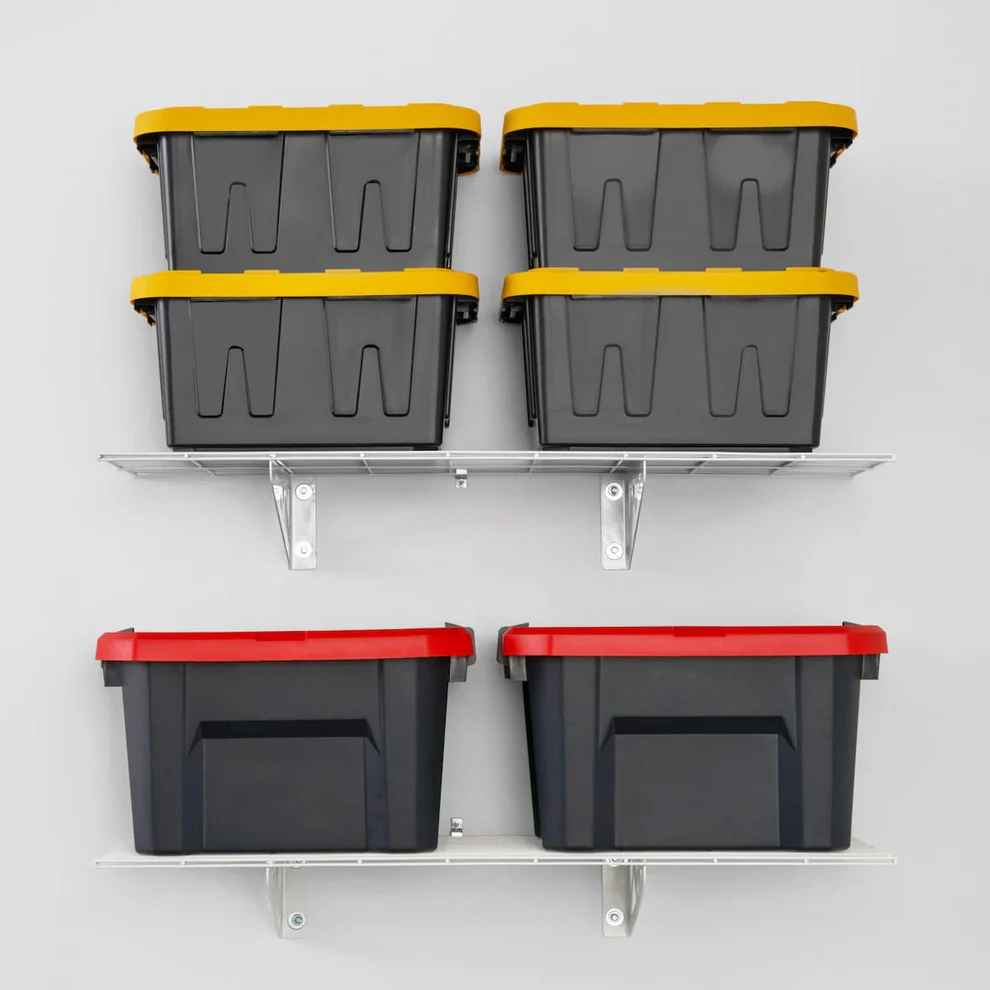
Don't neglect the walls. Wall-mounted storage systems complement overhead racks by giving frequently used tools, sports gear, and hobby equipment a vertical home that doesn't compete with floor space. Bikes on wall mounts. Garden tools on hooks. Sporting equipment on brackets. The walls of a garage, used intentionally, add significant organized storage without touching the floor or the ceiling.
Finish with floor space as the success metric. The measure of a successful garage spring clean isn't a prettier arrangement of the same stuff. It's a floor that's genuinely clear; where a car can pull in without navigating obstacles, where you can walk freely from the door to any point in the room, where the space looks and functions like a room rather than a storage unit you pay a mortgage on. That's the target. When you hit it, you'll know.
The Momentum Is Real - Use It
Behavioral researchers who study household organization have observed something that most people understand intuitively but rarely act on strategically: completing a large, visible task changes not just how we feel, but how we perceive the tasks that remain. The technical framing is progress motivation; the more clearly we can see that we've moved forward, the more capable we believe ourselves to be, and the more willing we are to continue.
The garage, cleared properly, is one of the most satisfying progress signals a home can generate. You can see the whole space at once. The before and after are side by side in your memory, separated by a single morning. And unlike a bedroom closet or a reorganized pantry shelf, a clean garage has a daily visibility that keeps that feeling alive. You drive through it every day. You walk past it every day. And every time you do, it quietly reinforces that you made something genuinely better.
Spring cleaning is harder to finish than it is to start. The seasonal energy that comes with longer days and warmer weather doesn't last indefinitely, and life has a well-established habit of reasserting its priorities before the hall closet gets touched. The strategy of starting with your highest-impact, most visible space (the one that will build the most momentum and create the most practical downstream benefit) isn't just good advice. It's the difference between a spring that actually feels like a fresh start and one that ends the same way it began.
The garage is waiting. It always is. But this spring, instead of walking past it on your way to a smaller, less satisfying task, consider going there first. The rest of the house will be easier. The momentum will be real. And the car, finally parked where it belongs, will be its own small daily reward.
Ready to reclaim your garage this spring? Visit storageshelvesbysaferacks.com to explore overhead storage options and find a certified installer near you, or call 877-655-3443 to get started.