
Most garage organization problems are not caused by a lack of space. They happen because everyday items, seasonal decorations, tools, sports equipment, and household supplies all compete for the same storage areas. The key is knowing what belongs on garage shelves, wall storage, and overhead garage storage racks. This guide explains a simple three-question system that helps homeowners organize any garage efficiently, maximize storage space, improve safety, and create a garage that stays organized long after the cleanup is finished.
If your garage has reached the point where you open the door, sigh, and close it again, you are in good company. Most cluttered garages are not the result of too little space. They are the result of too many decisions getting made one box at a time, usually while you are carrying something heavy and looking for anywhere to set it down.
The fix is not another trip to the store for more bins. It is a way to decide, quickly and consistently, where any given item actually belongs. Once you have that, the garage starts to organize itself.
This is the part companies like SafeRacks tend to understand well, because they build the three systems most garages rely on: garage shelving for standing height, wall storage for the things you grab on your way out, and overhead garage storage racks for the airspace above your car. But hardware is the last step, not the first. The first step is knowing what goes where, and why.
So before we talk about a single shelf, here is the rule that makes the rest easy.
Pick up any item in your garage and ask three quick questions. The answers tell you where it goes almost every time.
Not how often you think you might. How often you really do. Daily and weekly items need to be in arm's reach. Monthly and seasonal items can go a little higher or deeper. Things you touch once a year can go all the way up and out of the way.
Weight decides not just where something can go, but where it is safe to go. Heavy, dense items belong low and on something rated to hold them. Light, bulky items are the ones that earn a spot overhead, where lifting them up is easy and bringing them down is rare.
Some items shrug off a garage. Others do not. Heat, cold, moisture, and a four-foot fall onto concrete are all real risks. Anything fragile, anything that can leak, and anything that freezes or melts needs a home chosen with that in mind.
Frequency tells you how reachable it should be. Weight tells you what it can safely sit on. Vulnerability tells you what to keep away from. Hold those three answers in your head and the rest of this guide is mostly confirmation.
Freestanding garage shelving is the workhorse of the room. It lives at standing height, it is easy to load and unload, and a good steel unit holds a serious amount of weight. SafeRacks steel shelving, for example, carries up to 500 pounds per shelf and around 2,000 pounds across the unit, which is far more than the flimsy plastic shelving most garages start with.
That strength is exactly why shelves are the right home for the heavy, dense, everyday things.
Good candidates for shelves
Cleaning supplies. Paper towels and household overflow. Pet food and supplies. Automotive fluids and car-care products. Hand tools and small power tools. Paint and project supplies. The bins you open regularly, like hardware, fasteners, or gardening odds and ends.
The common thread is that these are items you want to see and reach without a ladder. Shelves keep them at eye level and off the floor, which is where most of this stuff ends up when it has nowhere else to go.
A small detail worth knowing: shelf decks are not all equal. Wire and steel decks handle damp garages well. Particleboard or MDF decks can warp or grow mold in high moisture, so in a humid or unheated garage, keep moisture-sensitive items off the lowest shelf and lean toward steel or wire surfaces.
What does not belong on shelves
A few things sneak onto shelves and cause problems. Anything you reach for several times a day is better on a wall hook than buried behind three bins. Extremely long items like rakes and ladders do not sit well on shelving and tend to slide off. And lightweight, rarely used seasonal bins are wasting prime real estate down here when they could be overhead.
What Belongs on Wall Storage
Walls are the most underused surface in almost every garage. People fill the floor, stack the shelves, and leave the vertical space between them completely empty. That space is the answer to half of your problems.
Wall storage is built for the long, awkward, grab-often items that never sit neatly on a shelf.
Yard tools, sports gear, and bikes
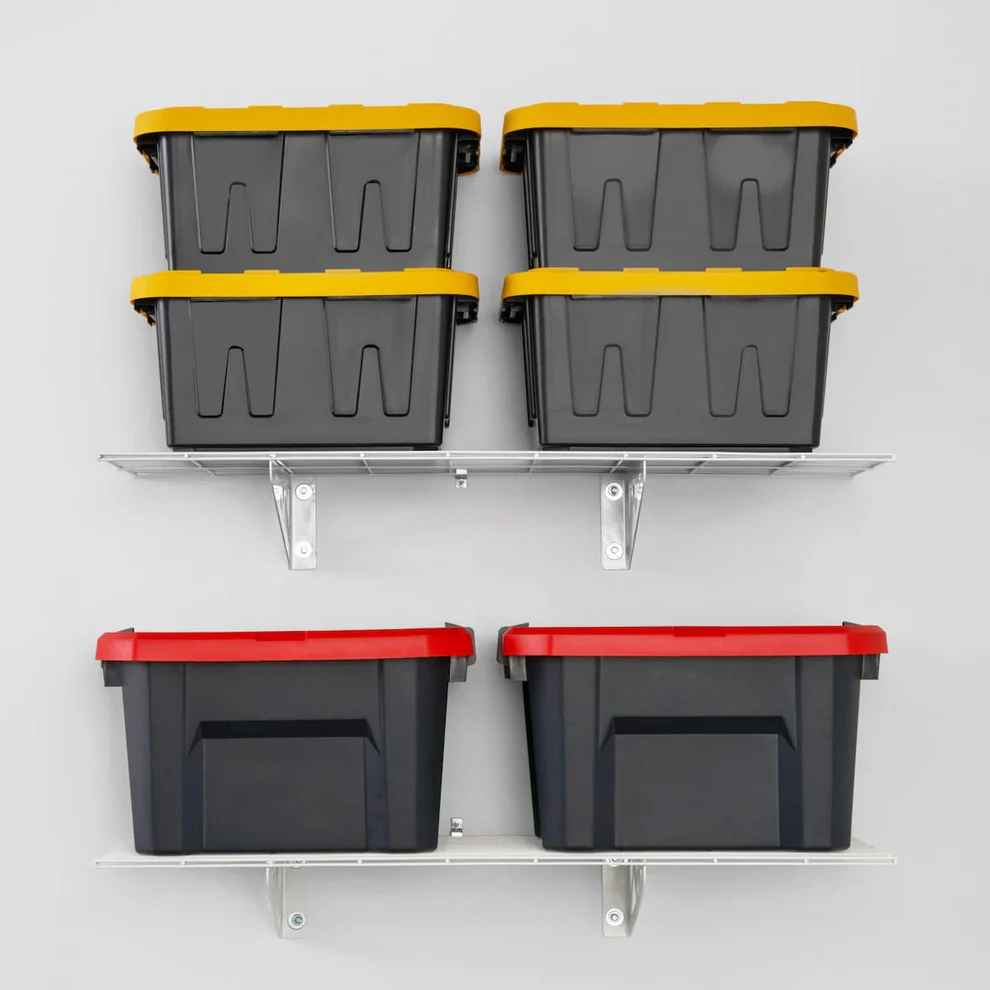
Rakes, shovels, brooms, and trimmers hang flat against the wall and stop falling over in a heap. Sports equipment like bats, helmets, balls, and folding chairs lives well on hooks and wire baskets, grouped so the kids can grab and return it without your help.
Bikes are the big win. A bike on the floor eats roughly ten square feet once you count the handlebars and pedals. The same bike on a wall hook takes up almost nothing. Steel wall shelves and heavy-duty hooks can hold real weight, often around 500 pounds for a mounted shelf, as long as the hardware lands in the studs and not just the drywall.
Why the walls stay empty
The reason most people skip the walls is simple: hanging things feels like more work than setting them down. It is, for about an hour. After that, it pays you back every single day, because the floor stays clear and everything has a visible home. Wall storage is the cheapest square footage in the garage, and it is just sitting there.
What Belongs Overhead
The space above your car is the largest block of unused storage in the house. Overhead garage storage racks turn that empty ceiling into real capacity without costing you a single square foot of floor.
The numbers are better than most people expect. A SafeRacks 4 by 8 foot overhead rack holds up to 600 pounds and adds as much as 120 cubic feet of storage on a single rack, built from 14-gauge industrial steel. Smaller racks scale down from there, with 250 to 500 pound capacities depending on size. That is enough for a lot of holiday decor, and it is all happening over your hood.
Good candidates for overhead
Overhead ceiling storage is made for items that are light to medium in weight, bulky, and rarely needed. Christmas and Halloween decorations. Seasonal bins. Camping gear like tents, sleeping bags, and coolers. Luggage and travel cases that come down twice a year. Keepsakes and long-term storage you want to keep but almost never open.
Run these through the three questions and they all qualify: rarely reached, not too heavy, and not easily ruined by living up high.
What should never go overhead
This is where safety matters most, so it is worth being clear.
Keep frequently used items off the ceiling. If you need it weekly, you should not be hauling out a step stool to get it.
Keep hazardous chemicals down low. Gasoline, propane, and pool chemicals do not belong over your head, both for fume reasons and because a leak overhead is a far bigger problem than a leak at floor level.
Keep extremely heavy loose items off overhead racks. The weight ratings are real, and a rack rated for 600 pounds will fail if you treat it like it holds a thousand. Distribute the load evenly and stay within the rating.
And keep fragile items out of overhead storage unless they are well protected. Anything that would shatter on the concrete below is a poor candidate.
One more safety point that is easy to miss: overhead racks bolt into the ceiling joists, into the structural wood, not the drywall. Getting that wrong is how racks come down. The average person can install one in a few hours, but if you are not certain you can hit the joists cleanly and spread the load, this is the part most worth handing to a professional. SafeRacks runs an installer network across more than 40 major cities for exactly this reason, with insured, background-checked pros.
Here is the quiet magic of working item by item: the zones build themselves.
Once your cleaning and car supplies are on shelves, your tools and yard gear are on the walls, and your seasonal bins are overhead, you look up and realize you have a home-maintenance area, a sports and recreation area, a seasonal storage area, and an open floor where you can actually work. You did not have to plan the zones. They fell out of putting each thing where it belonged.
That is the difference between a garage that looks organized for a weekend and one that stays organized for years. The system is not the bins or the racks. The system is the rule you used to place everything.
If there is one habit that quietly wrecks more garages than any other, it is storing things based on where there is room instead of how the item is actually used.
It happens to everyone. Something comes home, the nearest open spot gets it, and that becomes its permanent address. Over a couple of years, the bikes end up behind the holiday bins, the lawn mower sits in front of the camping gear, and every retrieval turns into a small excavation.
The fix is the three questions, applied honestly. The thing you use most should be the easiest to reach, even if that means moving something you rarely touch out of the prime spot it accidentally claimed.
There is a second half to this mistake, and it is the dangerous one: guessing at weight. A shelf rated for 40 pounds will not hold a tote full of hand tools. An overhead rack loaded past its rating can come down. This is the entire reason published weight capacities matter, and why it is worth choosing storage that lists real numbers instead of vague promises. When you know a shelf holds 500 pounds and a rack holds 600, you can load with confidence instead of hope.
A well-sorted garage is not just tidier. It returns value in three directions at once.
The first is safety. Heavy things sit on surfaces built to hold them. Chemicals stay low and ventilated. Nothing is balanced overhead that could come down on a car or a person. For a household with kids, or with anyone who would rather not wrestle a 50-pound bin off a high shelf, that peace of mind is the whole point.
The second is resale value. Buyers walk through garages, and they read them quickly. A garage with clean floors, items on real systems, and obvious capacity says the home has been cared for. A garage buried in piles says the opposite, fairly or not. Good garage storage systems are one of the few upgrades that help you while you live there and again on the day you sell.
The third is the simplest, and for a lot of people the most satisfying: the plain pleasure of walking into a garage where everything has a place. There is a real, daily kind of calm in opening the door and seeing order instead of a project you keep avoiding. You do not have to be a naturally tidy person to want that. You just have to set the system up once.
Shelves, walls, and overhead racks are not competing options. They each solve a different problem. Shelves hold the heavy, frequent, standing-height items. Walls handle the long and awkward gear you grab on your way out. Overhead racks bank the seasonal and rarely used things up and out of the way. Used together, guided by those three questions, they turn a garage from a place you dread into a room that actually works for you.
SafeRacks builds all three: overhead garage storage racks, freestanding and wall shelving, and the heavy-duty hardware to hold it, all backed by a lifetime warranty and a network of professional installers across more than 40 cities for the parts you would rather not do yourself.
If you are staring at a garage that feels like too much to tackle, you do not have to figure it all out at once. Start with the three questions, place a few things, and watch how fast it changes. And if you would like a hand designing a setup that fits your space, the SafeRacks team is easy to reach at saferacks.com/installation or 877-655-3443. No pressure either way. The best garage is the one you actually enjoy walking back into.
|
Solution |
Best For |
Key Limitation |
|
Overhead ceiling racks |
Seasonal/bulky items |
Ladder access required |
|
Wall slatwall/French cleats |
Tools, gear, frequent access |
Limited by wall availability |
|
Pegboard |
Hand tools, hardware |
Weight limits per hook |
|
Freestanding shelving |
Flexibility, lower cost |
Uses floor space |
|
Enclosed cabinets |
Hazardous materials, aesthetics |
Higher cost |
|
Bike hoists |
Single or few bikes |
Per-unit installation |
|
Kayak/canoe cradles |
Large watercraft |
Ceiling height required |
|
Fold-down workbench |
Occasional workspace |
Not suitable for heavy continuous use |
Putting It Together: There's No Single Right Answer
The garages that work best are almost always the ones that layer solutions: overhead racks for seasonal bulk, wall systems for tools and sporting equipment, enclosed cabinets for hazardous materials, and a zoned floor plan that protects vehicle parking.
No single product category solves a garage. A set of beautiful cabinets won't help if the ceiling is holding nothing. Overhead racks won't help if the floor is still overwhelmed with gear that needs better categorization.
The sequence matters too: declutter first, then plan zones, then choose storage solutions to serve each zone. Buying storage before you've sorted what you're keeping is one of the most common mistakes homeowners make, and one of the most expensive.
For homeowners looking to start with the solution that returns the most new space per dollar, overhead ceiling racks are consistently among the strongest choices. Systems like SafeRacks, with adjustable height, high weight capacity, and professional installation available in 40-plus cities, are built specifically for this: turning the empty ceiling zone above your cars into 100-plus cubic feet of usable storage without touching a single square foot of floor.
But the ceiling is just one layer. Build the full system, and you'll have a garage that actually works, not just one that looks organized until the next rainy weekend.