
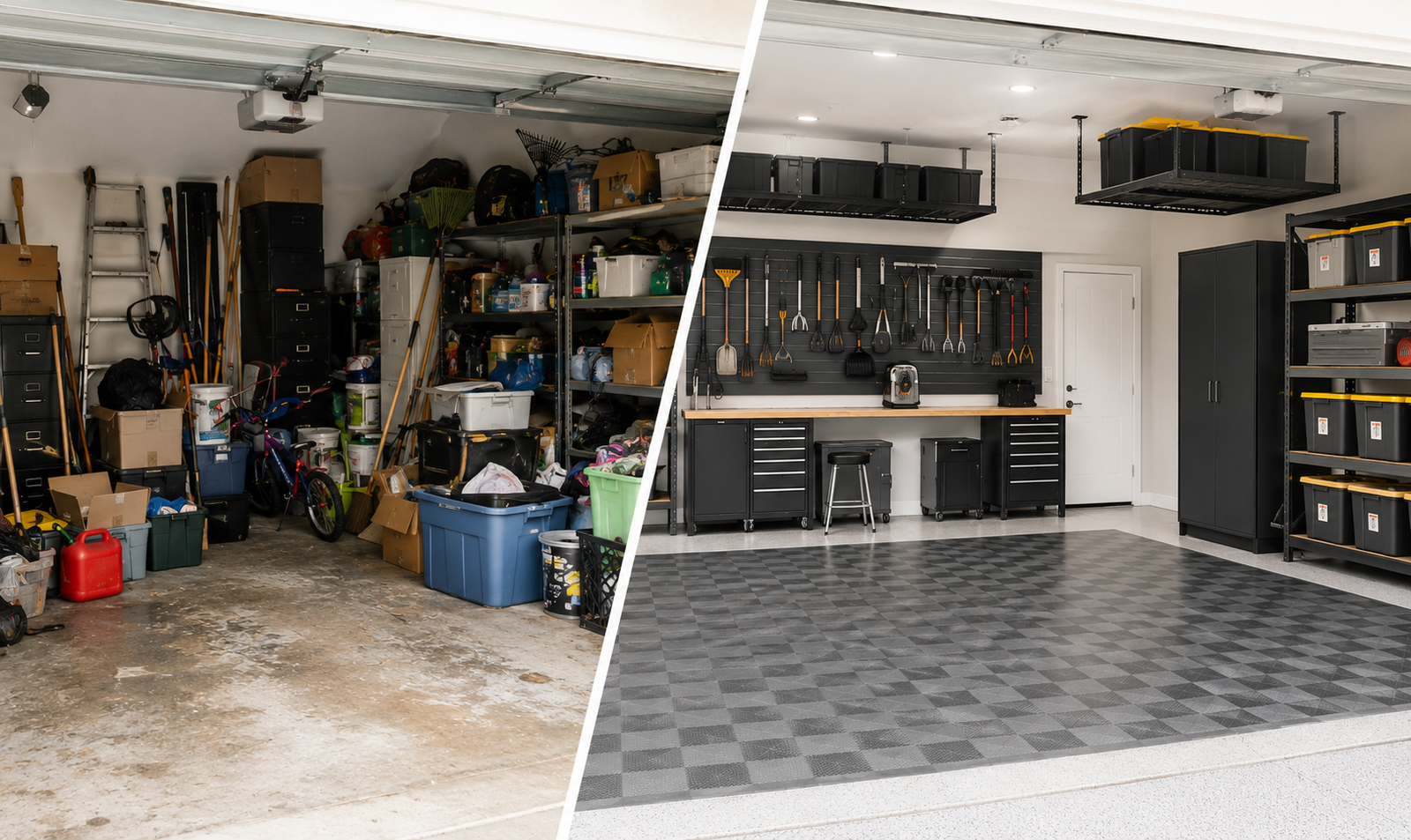
Most garage makeovers do not need to cost thousands of dollars. The right budget depends on what you actually need the garage to do. A basic cleanout may cost almost nothing, while junk removal typically costs a few hundred dollars. Adding shelving, wall storage, or overhead garage racks can create significantly more usable space without a major renovation. Professionally planned and installed garage storage commonly moves into the low thousands, while custom cabinetry, flooring, lighting, insulation, and other upgrades can push a complete garage makeover well into five figures. Before setting a budget, decide whether your real goal is simply parking the car, creating household storage, adding a workspace, or building a finished showpiece garage.
Stand in the doorway of a cluttered garage, and it is easy to assume you need a big project. A whole new floor. Rows of matching cabinets. The kind of garage you saw on a home renovation show.
Most people do not need that. What they need is to decide what they actually want the garage to do … and what their budget is.
Maybe you just want to park the car inside again. Maybe you want the garage to hold the household overflow that has no home. Maybe you want real shelving and overhead storage. Maybe you want a workbench. Maybe you would rather have someone else figure out where everything goes and install it for you.
All of those are reasonable goals, and they cost wildly different amounts. Somewhere in the practical middle of that spectrum sit companies like SafeRacks, which make 600-pound-capacity overhead ceiling racks along with wall shelving, freestanding steel and wire shelves, bins, workbenches, and floor tiles, and offer professional installation through a certified installer network in more than 40 cities. Hold that thought, because the first move is not buying anything.
This guide walks the full range, from an empty-your-driveway cleanout to a five-figure custom build, so you can find the level that matches your household instead of someone else's Pinterest board.
The cheapest garage improvement is almost always getting rid of stuff.
Before you shop for a single shelf, try the old-fashioned method. Pull everything out, spread it across the driveway, and sort it into keep, donate, and toss. It may be a miserable Saturday, but a genuinely useful one, because plenty of people discover that once the junk is gone, the garage doesn't need an elaborate system at all.
Here is what disposal costs in 2026. If you haul it yourself, you mostly pay landfill fees, often around $30 to $80 in dump-run disposal costs. A dumpster bag that a hauler picks up later tends to cost $100 to $180 per week, and the smallest rented dumpsters run roughly $75 to $200 a week.
If you would rather not touch any of it, full-service junk removal for a typical two-car garage generally costs $150 to $500, and a packed three-car or oversized garage can reach $400 to $800 or more. Donation pickups and recycling can bring that number down, and some towns offer free or low-cost bulk pickup if you can wait for a scheduled day.
The point is simple. You can meaningfully improve a garage for well under a few hundred dollars before you buy any storage at all.
The goal here is floor space, nothing more.
You are not building a system. You are clearing the concrete so a vehicle fits. After the cleanout, the fastest win is moving seasonal and rarely used items off the floor and into the air. The ceiling above where your car parks is usually dead space, and that is exactly where holiday bins, camping gear, and luggage belong.
This is where overhead racks earn their keep. A single ceiling rack turns unused space above the hood into a platform for the bulky stuff you touch a few times a year. SafeRacks overhead racks, for reference, hold up to 600 pounds and run from under $100 for a small unit to around $200 for a standard four-by-eight foot rack. Add a basic freestanding shelving unit against a side wall, often $75 to a couple hundred dollars, and many garages hit "the car fits again" for a few hundred dollars total.
If parking is your only goal, resist the urge to overbuy. One or two racks and a shelf may be the entire project.
Here the garage becomes an honest extension of your household storage.
This is the level for people whose closets are full, whose bulk paper towels have nowhere to live, and whose holiday decorations migrate around the house all year. The garage can absorb all of it, but only if you build storage rather than just relocating the mess.
There is a real difference between shuffling clutter into the garage and creating something that stays useful for years. Moving boxes from the hall closet to a garage floor pile solves nothing. Durable shelving, labeled bins, wall-mounted storage, and overhead racks solve it for good. Expect garage shelving to cost between $100 and $1,000, depending on whether you buy a single freestanding unit or a full wall of it.
One practical durability note worth keeping in mind. If part of your garage stays humid, skip shelving with MDF or particleboard decks, which can swell and warp in damp air. All-steel and wire-grid shelving hold up in those conditions, which matters if you are storing anything you actually care about.
Now layout matters more than the products.
An organized garage is not one with the most shelves. It is one where the things you reach for every week sit at eye level or below, and the things you touch twice a year live overhead or in a corner. Bikes, lawn equipment, power tools, sports gear, and household supplies all want different homes, and cramming them onto identical shelves is how "organized" garages fall apart by spring.
The mistake almost everyone makes is buying storage before deciding where things go. Sort by how often you use something first. Daily and weekly items get the prime, easy-to-grab real estate. Put monthly items a little higher or farther away. Rarely used items go overhead. Only after that plan is in place should you decide what to buy.
Wall systems become useful at this level. Slatwall and track systems, which let you hang and rearrange tools and gear, $79 to $1,000 for a wall depending on size and accessories. Most well-organized two-car garages combine overhead racks, some shelving, and a stretch of wall storage rather than relying on a single product.
Some people need the garage to do more than one job. Parking plus tinkering. Storage plus gardening. A place to build, repair, pot plants, or work on the car.
That changes the math, because you now have to protect open working space instead of filling every square foot. A workbench is usually the anchor. A wall-mounted folding bench keeps the footprint small when you are not using it, while a fixed bench gives you a permanent station. Pair it with pegboard or track storage above so your most-used tools stay within arm's reach of where you actually work.
The trick at this level is discipline about the floor. It is tempting to keep adding shelves and cabinets until the workspace disappears. Push storage up the walls and onto the ceiling specifically so the middle of the garage stays clear enough to move around and get things done. A workbench you cannot reach is just another shelf.
This is a real and underrated category. Plenty of people can afford good storage and are perfectly handy, but do not want to make the decisions or hang heavy racks over their cars.
There is genuinely a lot to get right. Where the overhead racks should go. How many you need. Where shelving makes sense and where it wastes space. What has to stay accessible. How the open garage door swings and where the ceiling joists actually run, since overhead racks must anchor into structural framing rather than drywall. How much clearance to leave above the car. And how to mount several hundred pounds overhead so it stays put.
Hiring that out is straightforward to price. General garage organizing pros commonly charge $55 to $75 an hour and book a three- to four-hour minimum. A single overhead rack often runs about $299 to $599. A whole-garage organization project, planned and installed, tends to land between roughly $2,000 and $6,000, with the average professionally installed system around $3,500 and most homeowners spending $2,000 to $5,000.
This is a natural place to mention SafeRacks, because it is one established national option for exactly this situation. The company sells the racks and shelving and also runs a certified installer network across more than 40 cities, and an installer typically needs about an hour per rack. You can reach that side of the business at 877-655-3443 or saferacks.com/installation, and it is worth getting a quote for your specific garage rather than assuming a price.
SafeRacks isn't the only company doing this, and it doesn't pretend to be. Local handymen, closet and garage design firms, and other national brands also install storage. The reason to consider a company like SafeRacks is durable products plus experienced installers under one roof, which appeals to people who want the result without the ladder.
Some homeowners want the full showpiece, and there is nothing wrong with that. This is simply a different project from solving ordinary storage problems, and the price reflects it.
Premium finishes add up fast. A coated garage floor for a two-car space typically runs $2,000 to $5,400 professionally installed, and decorative or higher-end coatings and tiles push a full floor makeover closer to $3,000 to $7,000. Cabinetry ranges from about $500 to $4,000 in a small garage, $2,000 to $5,000 in a two-car garage, and $2,500 to $10,000 or more in a three-car garage, with fully custom systems running past $10,000 to $15,000. Add insulation at $1,000 to $5,000, then finished walls, upgraded lighting, climate control, and automotive equipment on top.
Put it together and a full garage makeover commonly lands somewhere in the $8,000 to $25,000 range, with more extensive builds climbing toward $45,000. Converting the garage into finished living space is a different animal entirely and often runs into the tens of thousands and beyond.
None of that is foolish if it is what you want. Just go in clear-eyed about which project you are actually doing. And notice one thing that survives even the fanciest renovation. A beautiful garage still needs somewhere to put things, which is why storage racks and shelving usually show up in the finished ones too.
Read back through those levels and one usually fits your household better than the rest. The progression is roughly this: a DIY cleanout, then paid junk removal if you would rather not haul it, then basic organization to park the car, then quality shelving and overhead storage for real household needs, then professionally installed systems, then a full custom garage at the top.
You don't need somebody else's dream garage. You need one that works for your household and budget.
If clearing out years of junk fixes it, that is a win, and it cost you a weekend. If a couple of racks and a run of shelving get your car back inside, that is a win too. If professionally installed overhead storage and shelving finally create the space you have been missing, SafeRacks can handle both the products and the installation. And if you are building the showpiece, enjoy it.
The goal was never to spend the most money. The goal is to make the garage do what you need it to do.
|
Solution |
Best For |
Key Limitation |
|
Overhead ceiling racks |
Seasonal/bulky items |
Ladder access required |
|
Wall slatwall/French cleats |
Tools, gear, frequent access |
Limited by wall availability |
|
Pegboard |
Hand tools, hardware |
Weight limits per hook |
|
Freestanding shelving |
Flexibility, lower cost |
Uses floor space |
|
Enclosed cabinets |
Hazardous materials, aesthetics |
Higher cost |
|
Bike hoists |
Single or few bikes |
Per-unit installation |
|
Kayak/canoe cradles |
Large watercraft |
Ceiling height required |
|
Fold-down workbench |
Occasional workspace |
Not suitable for heavy continuous use |
Putting It Together: There's No Single Right Answer
The garages that work best are almost always the ones that layer solutions: overhead racks for seasonal bulk, wall systems for tools and sporting equipment, enclosed cabinets for hazardous materials, and a zoned floor plan that protects vehicle parking.
No single product category solves a garage. A set of beautiful cabinets won't help if the ceiling is holding nothing. Overhead racks won't help if the floor is still overwhelmed with gear that needs better categorization.
The sequence matters too: declutter first, then plan zones, then choose storage solutions to serve each zone. Buying storage before you've sorted what you're keeping is one of the most common mistakes homeowners make, and one of the most expensive.
For homeowners looking to start with the solution that returns the most new space per dollar, overhead ceiling racks are consistently among the strongest choices. Systems like SafeRacks, with adjustable height, high weight capacity, and professional installation available in 40-plus cities, are built specifically for this: turning the empty ceiling zone above your cars into 100-plus cubic feet of usable storage without touching a single square foot of floor.
But the ceiling is just one layer. Build the full system, and you'll have a garage that actually works, not just one that looks organized until the next rainy weekend.