Many homeowners assume they need a backyard shed when their garage fills up, but that's not always the most cost-effective solution… but it could be the right one. This guide compares the true cost of buying a shed versus maximizing the storage space already available in your garage with overhead storage, shelving, and organization systems. Learn which option makes the most sense based on your budget, your belongings, and how you use your space.
8 Questions to Ask Before Buying a Backyard Shed
Which Is the Better Value: A Backyard Shed or Garage Organization?
How to decide whether your storage problem needs a new structure or just better use of what you already own.
Every homeowner hits the same wall eventually. The garage fills up, the closets overflow, and the seasonal bins have nowhere to go. At that point, a backyard shed starts to look like the obvious answer. More square footage, a clean slate, a place to put everything that no longer fits.
It is a reasonable instinct. A shed can be a genuinely good investment for the right household. But before spending a few thousand dollars on a new structure, it is worth asking a quieter question. Is the storage space you already own actually full, or is it just poorly used?
For a lot of homes, the honest answer is the second one. A typical two-car garage holds far more than its floor suggests, and the ceiling above it usually sits completely empty. That gap between what a garage could hold and what it currently holds is where companies like SafeRacks focus. SafeRacks designs overhead garage storage systems, along with freestanding shelving, wall organization, and other solutions, and offers a certified installer network in more than 40 metropolitan areas for homeowners who would rather not handle the mounting themselves. The idea is straightforward. Make use of the space you have paid for before paying for more.
This article walks through both options honestly. Sheds have real advantages, and so does better garage organization. The right choice depends on what needs storing, how often it gets used, and how much of the garage is currently going to waste.
What a Quality Shed Actually Costs
The sticker price on a shed rarely tells the whole story. A small resin or metal unit under 100 square feet can start around $800 to $1,500, which sounds manageable. But that figure usually covers the structure alone.
The national average for an installed utility shed lands closer to $3,350, with most homeowners spending somewhere between $1,875 and $8,250 depending on size and material. A mid-size prefab kit in the 100 to 200 square foot range typically runs $1,500 to $4,000. Custom-built wood sheds climb well past that.
The costs that catch people off guard are the ones that ride along behind the shed itself. A proper foundation, whether a gravel pad or a concrete slab, can add anywhere from a few hundred dollars to $2,000. Delivery and assembly often run another $200 to $1,500. If the build is large enough to require a permit, that is another $100 to $500. Add electrical wiring, and the bill grows by $500 to $2,000 more.
It helps to run the numbers on a real example. Say a homeowner finds an attractive mid-size shed for $1,500. That is the figure they budget around. Then the details arrive. A gravel pad to keep the floor off the dirt runs $600. Delivery and assembly add $700. The size crosses the local permit threshold, so that is another $250. Suddenly the $1,500 shed is a $3,050 project before a single item goes inside, and that is without electrical or a concrete slab. The structure was never the expensive part. Everything around it was.
There is also upkeep to account for. Wood sheds need painting or sealing and can cost $100 to $500 a year to maintain. Even low-maintenance materials eventually show wear. A budget resin shed may only last around seven years, while a quality wood or vinyl structure can last two or three decades with care.
None of this makes a shed a bad purchase. It just means the real number is usually higher than the price tag, and worth calculating fully before deciding.
How Much Garage Space Sits Empty
Here is the part most homeowners overlook. The floor of a garage is only a fraction of its actual storage capacity.
A two-car garage offers roughly 400 to 500 square feet of floor space. But a garage is not a flat surface. It is a room with height, usually at least eight to ten feet of it. The space from head height to the ceiling, running the full footprint of the garage, is almost always empty. In most homes, that vertical zone holds nothing at all.
This is where thinking in cubic feet instead of square feet changes the math. Square footage measures the floor. Cubic footage measures the room. When a homeowner only stores things on the ground, along the walls, or in leaning stacks, they are using a small slice of what the garage can actually hold.
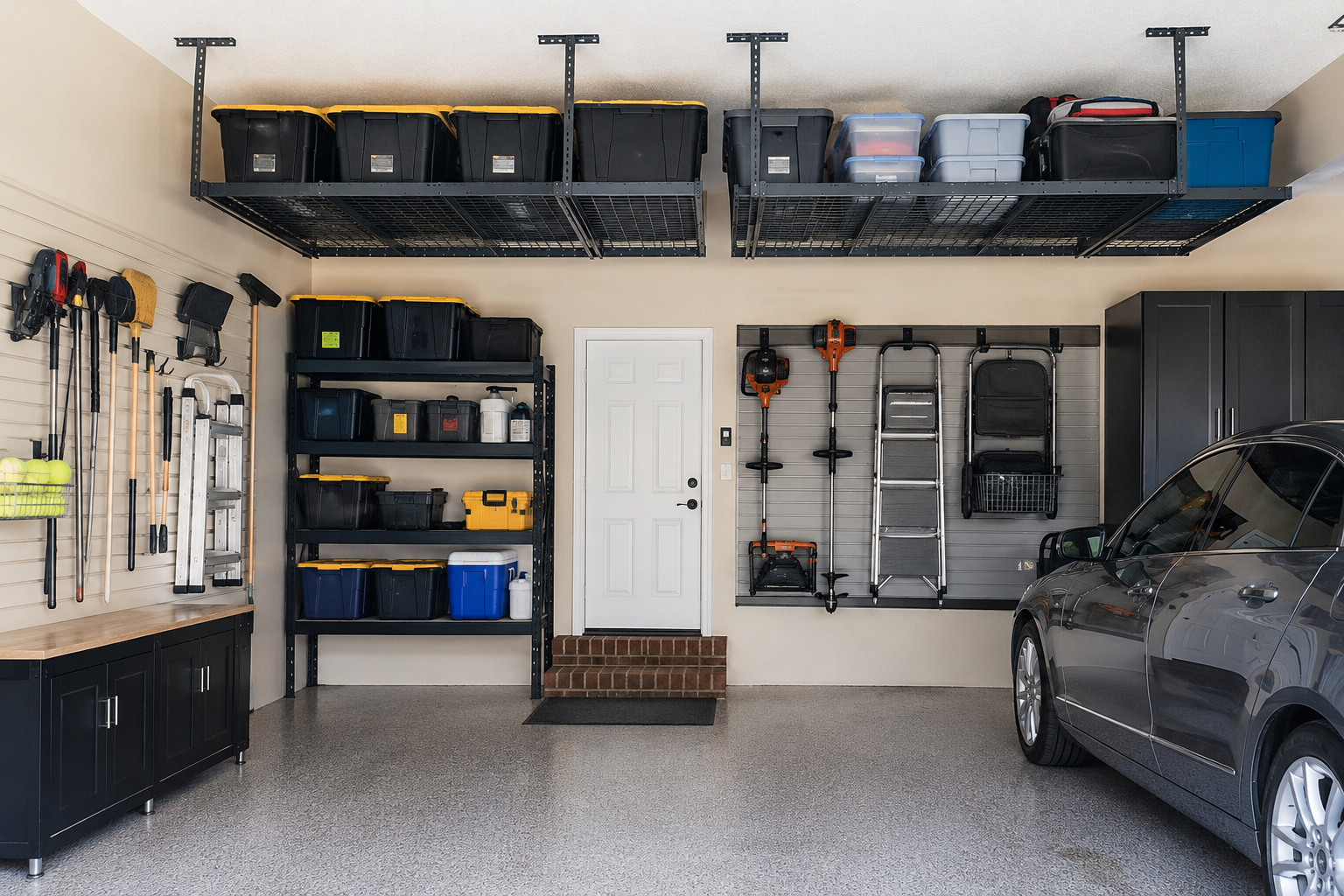
Overhead storage is what puts that unused volume to work. A single 4-by-8 SafeRacks overhead rack, mounted to the ceiling, holds up to 600 pounds and provides as much as 120 cubic feet of storage at full drop height. That is a meaningful amount of space appearing in a spot that was doing nothing before, without giving up a single square foot of floor.
For comparison, that 120 cubic feet is a real portion of what many people are hoping a shed will provide. The difference is that the ceiling is already there, already paid for, and already inside a structure that stays dry and secure.
Which Items Belong in a Garage, and Which Belong in a Shed
The smartest storage decisions come down to matching the item to the location. Not everything belongs overhead, and not everything belongs in a shed.
Overhead garage racks work best for things that are bulky, seasonal, and used a few times a year. Holiday decorations are the classic example. So are camping gear, coolers, sporting equipment, luggage, and the plastic storage bins that pile up in every household. These items are light enough to lift, infrequent enough that ceiling access is no burden, and much happier in a climate-protected garage than in an outdoor structure.
Things that get used often, or that would suffer outdoors, also belong inside. Anything sensitive to temperature swings and moisture, like certain paints, adhesives, electronics, or paper goods, does better in the more stable environment of an attached garage. So do items a homeowner reaches for regularly, since a trip across the yard in the rain gets old quickly.
A shed earns its keep with a different category. Gas-powered lawn equipment is the strongest example. Mowers, trimmers, leaf blowers, and the fuel that runs them are often better kept out of an attached garage for safety and fumes. Landscaping tools, wheelbarrows, potting supplies, bags of soil and mulch, and pool equipment all make sense in a shed too. These are things used outdoors, stored near where they are used, and not harmed by a less controlled environment.
Seen this way, the two solutions are not really competitors. They handle different jobs.
When a Shed Makes the Most Sense
For all the value in organizing a garage first, a shed is sometimes the correct answer, and it helps to be clear about when.
The clearest case is outdoor equipment. A lawn tractor, a push mower, a wheelbarrow, and a full set of landscaping tools take up real floor space and get used outside anyway. Keeping them in a shed near the yard, rather than crowding the garage, is often the more practical arrangement.
Fuel and gas-powered engines are another factor. Many homeowners prefer to keep gasoline, mowers, and trimmers out of an attached garage entirely, away from living space and the vehicles parked inside. A shed gives those items a dedicated home.
There is also the question of sheer volume. Some households simply own more than a garage can reasonably hold, even a well-organized one, especially if the garage still needs to fit one or two cars. In those cases a shed adds genuine capacity rather than masking an organization problem.
And for some, a shed is about more than storage. It becomes a potting station, a workshop, or a hobby space. That is a different purchase with its own logic, and organizing the garage will not replace it.
The point is not that sheds are unnecessary. It is that a shed works best when it solves a problem the garage genuinely cannot, rather than one the garage could have solved for far less.
Security, Weather, and Everyday Convenience
Beyond cost, three practical factors separate a garage from a shed.
Security is the first. An attached garage sits within the home's locked, often alarmed footprint. A backyard shed is a separate structure, frequently secured by nothing more than a padlock. For anything valuable, the garage is the safer place by a wide margin.
Weather protection is the second. Garages are buffered by the house around them and stay far more stable in temperature and humidity than a standalone shed. A cheaper shed can trap moisture, and without proper ventilation and a solid foundation, dampness becomes a real problem for whatever is stored inside.
Convenience is the third, and it is easy to underestimate. Items stored overhead in the garage are a few steps and a short reach away. Items in a shed require walking outside, in whatever weather, to a separate building. For daily or weekly use, that difference adds up. For something touched twice a year, it matters much less.
HOA Rules, Permits, and Property Limits
A shed is not always a homeowner's decision to make alone. Several outside factors can complicate, delay, or block the project entirely.
Homeowners associations frequently require approval before a shed goes up, and some restrict size, placement, color, or material. In certain communities, sheds are not permitted at all. It is worth checking the HOA rules before getting attached to a plan.
Permits are another consideration. Many areas require a permit once a shed passes a certain size, often somewhere around 120 to 200 square feet. Setback rules commonly require the structure to sit several feet back from property lines, which limits where it can go on a given lot.
Then there is the yard itself. A shed consumes outdoor space that might otherwise be lawn, garden, or play area. On a smaller lot, that trade-off is significant. Overhead garage storage, by contrast, needs no approval, no permit, and no yard. It works within a structure that already exists.
A Simple Way to Decide
The choice becomes clearer with a few honest questions.
Start by looking up. If the garage ceiling is empty and the upper walls are bare, there is likely a large amount of untapped storage sitting right there. Clearing the floor by moving seasonal and bulky items overhead often solves the exact problem that sent a homeowner shopping for a shed in the first place, at a fraction of the cost.
Then consider what actually needs storing. If the overflow is mostly bins, decorations, gear, and household items, the garage can almost certainly absorb it with the right system. If the overflow is mostly lawn equipment, landscaping tools, and gas-powered machines, a shed may be the better home for those specific things.
For many households, the real answer is not one or the other. It is both, used well. An organized garage handles the indoor overflow and everyday gear, while a modest shed takes the outdoor equipment that does not belong inside anyway. The mistake is buying the shed first, before finding out how much the garage could have held on its own.
The Point Isn't Always More Space
Creating more storage is not always about building more of it. Often it is about using what already exists.
Before investing thousands in a new structure, it is worth spending an afternoon taking honest stock of the garage. Measure the empty ceiling. Look at the bare upper walls. Picture the seasonal bins lifted off the floor and out of the way. In a lot of homes, the storage problem turns out to be an organization problem, and it can be solved without a single new square foot.
If a shed still makes sense after that, it will make sense for the right reasons, and it will probably be a smaller, cheaper, more useful one.
For homeowners who want to see what their existing garage could hold first … SafeRacks offers overhead storage systems, freestanding shelving, and professional installation built to reclaim that wasted vertical space. It is worth exploring whether better organization solves the challenge before a backyard shed enters the budget. The space may already be there, just waiting overhead.
|
Solution |
Best For |
Key Limitation |
|
Overhead ceiling racks |
Seasonal/bulky items |
Ladder access required |
|
Wall slatwall/French cleats |
Tools, gear, frequent access |
Limited by wall availability |
|
Pegboard |
Hand tools, hardware |
Weight limits per hook |
|
Freestanding shelving |
Flexibility, lower cost |
Uses floor space |
|
Enclosed cabinets |
Hazardous materials, aesthetics |
Higher cost |
|
Bike hoists |
Single or few bikes |
Per-unit installation |
|
Kayak/canoe cradles |
Large watercraft |
Ceiling height required |
|
Fold-down workbench |
Occasional workspace |
Not suitable for heavy continuous use |
Putting It Together: There's No Single Right Answer
The garages that work best are almost always the ones that layer solutions: overhead racks for seasonal bulk, wall systems for tools and sporting equipment, enclosed cabinets for hazardous materials, and a zoned floor plan that protects vehicle parking.
No single product category solves a garage. A set of beautiful cabinets won't help if the ceiling is holding nothing. Overhead racks won't help if the floor is still overwhelmed with gear that needs better categorization.
The sequence matters too: declutter first, then plan zones, then choose storage solutions to serve each zone. Buying storage before you've sorted what you're keeping is one of the most common mistakes homeowners make, and one of the most expensive.
For homeowners looking to start with the solution that returns the most new space per dollar, overhead ceiling racks are consistently among the strongest choices. Systems like SafeRacks, with adjustable height, high weight capacity, and professional installation available in 40-plus cities, are built specifically for this: turning the empty ceiling zone above your cars into 100-plus cubic feet of usable storage without touching a single square foot of floor.
But the ceiling is just one layer. Build the full system, and you'll have a garage that actually works, not just one that looks organized until the next rainy weekend.