How families can reclaim usable garage space and put off the move they may not actually want to make
Growing families do not always need a bigger house. Sometimes they need a better-organized garage. By using overhead storage, wall systems, shelving, and professional garage organization, homeowners can reclaim usable space, park cars inside again, and make a smaller home work longer before considering a costly move.
9 Ways the Garage Can Help a Smaller Home Work Longer
Before You Move, Look at What the Garage Can Give Back
Most families don't outgrow their house all at once. It happens in slow motion. The crib comes out, then the toddler bed, then the bigger kid bed. Sports seasons start, holidays come and go, and somewhere along the way, the garage stops being a garage. By the time both kids are old enough to pack their own backpacks, the cars are sitting in the driveway, and the family has more or less forgotten what the garage floor even looks like.
This is the moment many homeowners start asking whether it's time to move.
Before that conversation gets too far, it is worth taking an honest look at the garage. Companies like SafeRacks, which specialize in overhead storage systems, shelving, and full garage organization solutions, see this pattern all the time. Families think they need a bigger house when what they really need is more usable space in the house they already have. Almost every time, that hidden square footage is hiding behind a wall of plastic bins and a stack of folding chairs nobody has used since 2019.
The Hendersons, and Probably Half the Neighborhood
Take a hypothetical family. Call them the Hendersons. They bought a three-bedroom starter home nine years ago, thinking they would be there for five. Their kids are now seven and ten. The garage was supposed to hold two cars and maybe a small workbench. Today it holds two bikes the kids have already grown out of, three storage bins of holiday lights, a deflated kiddie pool, a set of hand-me-down skis from a cousin, four boxes labeled "kitchen stuff" from the last move, a snowblower, a lawnmower, and a stroller they keep meaning to donate.
The cars sit outside year-round. In the winter, mornings start with a scraper and cold hands. In the summer, the inside of the car is hot enough to peel paint.
The Hendersons have started looking at bigger houses. Mortgage rates are higher than they want, prices in their school district are higher than they expected, and every Saturday open house feels like work. The truth is, they like their home. They like their neighbors. The kids walk to school. They just feel like they are running out of room.
What they are really running out of is functional storage, not square footage.
The Question Most Families Ask Too Early
There is a window in most families' lives where moving feels like the only answer. The kids are getting bigger, the stuff is getting bigger, and the house seems to be getting smaller by the month. Closets are jammed. The basement is jammed. The garage is so jammed that nobody parks in it anymore.
But before signing up for a year of house hunting, packing, and a new mortgage at a higher rate, it is worth asking a different question. How much of the daily stress in the home is actually coming from the garage?
For most families, the answer is a lot.
Garages are the largest single storage area in the typical American home. A standard two-car garage runs about 400 to 500 square feet. That is bigger than most primary bedrooms. When that space is used as a chaotic dumping ground rather than as organized storage, the rest of the house has to pick up the slack. Bins migrate to bedrooms. Sports gear ends up in the entryway. Holiday decorations live under beds. The whole house feels cramped because the largest storage room has been quietly disabled.
Reclaiming the garage does not fix everything. But it often fixes more than people expect.
How Garages Slowly Become Overflow
Nobody decides to give up their garage. It happens one bin at a time.
A new baby brings a stroller, then a double stroller, then a wagon. T-ball brings a bag of bats and helmets. Soccer brings cleats in three sizes. Camping trips happen once, and the gear stays out for a year. Holiday boxes multiply because nobody wants to throw away the lights that still work. The pandemic hobby lives on a shelf. Old paint cans, leftover tile from a bathroom redo, a ladder, two ladders, a third ladder borrowed from a neighbor, and never returned.
Each item arrives for a real reason. The problem is not the stuff. The problem is that the garage was never set up to hold any of it in an organized way. Most garages are sold as empty boxes. Drywall, a concrete floor, a couple of outlets, and a door. Whatever happens after move-in is improvised.
That is why even tidy families end up with garage chaos eventually. Without a system, stacking is the only strategy. And stacking only works until something on the bottom is needed.
What Reclaiming a Garage Actually Looks Like
The goal is not a magazine garage. The goal is a garage that works.
For most families, that means three things. The cars fit inside again. The stuff that lives in the garage is findable in under a minute. And nobody has to move three things to get to a fourth.
That is a realistic target. It does not require a renovation. It does not require throwing away most of what is currently in there. It mostly requires using the space differently, especially the parts that are currently empty. Which, for almost every garage, means the walls and the ceiling.
Start With What Is Actually in There
Before buying a single hook or rack, it helps to spend an afternoon sorting. Not deep cleaning. Just sorting.
Three piles tend to be enough. Keep, donate, and gone. The keep pile gets organized into rough categories. Sports. Tools. Holiday. Kids. Garden and outdoor. Automotive. Whatever the family actually has.
Most homeowners are surprised by how much of the garage is taken up by things nobody wants. Empty boxes from electronics that are long out of warranty. Broken folding chairs. Toys the kids outgrew years ago. A bike with two flat tires and a missing pedal. Once those leave, the real storage problem is usually about half the size it looked like.
Mapping the Garage to How the Family Actually Lives
After sorting comes layout. This is the step most homeowners skip, and it is the one that pays off the most.
Items that get used every week should be easy to grab. Items that come out twice a year can live higher up or further back. Items that come out once a year, like holiday decorations or summer pool gear, are perfect candidates for overhead storage where they are out of the way but still accessible.
A simple way to think about it: daily and weekly stuff goes on the walls at standing height. Monthly and seasonal stuff goes on shelves. Once-a-year stuff goes overhead. The floor stays as clear as possible.
This is where most garages go wrong. Things end up wherever there was room when they came home from the store. The bikes are behind the holiday bins. The lawn mower is in front of the camping gear. Every retrieval becomes a project. Reorganizing around how the family actually uses the garage solves more problems than buying more storage ever will.
Going Up: Vertical Space Is the Workhorse
In a typical garage, the walls and the ceiling are mostly empty. That empty space is the answer to almost every storage problem a family has.
Overhead Racks for the Long-Term Stuff
Overhead storage racks mount to the ceiling and hold the things a family needs but rarely uses. Holiday decorations. Camping gear. Off-season clothes. Luggage. Old keepsakes. The boxes that have been sitting in the corner for three years waiting for somebody to deal with them.
A standard SafeRacks 4 by 8 foot overhead rack holds up to 600 pounds and is built from 14 gauge industrial steel, which is enough capacity for a serious amount of holiday decor and seasonal gear. Two racks essentially double the usable storage in most garages without taking up a single square foot of floor space.
The catch with overhead storage is that it has to be installed correctly. These racks bolt into the ceiling joists. The hardware has to land in the structural lumber, not just the drywall, and the load has to be distributed safely. This is one of the main reasons many homeowners hire professional installers for overhead racks rather than doing it themselves. More on that in a minute.
Wall Storage for the Daily and Weekly Stuff
Walls are where the active gear should live. Bikes. Scooters. Helmets. Garden tools. Brooms. Folding chairs. Ladders. The leaf blower. Anything someone in the family touches on a regular basis.
Wall storage comes in several forms. Slat wall systems, which let users hang and rearrange hooks anywhere along a track. Pegboard, which is cheaper and works well for hand tools. Heavy duty hooks that bolt into studs and can hold a bike or a ladder. Wire grids for sports balls. The right mix depends on what the family has.
The big win with wall storage is that it gets things off the floor. A wall-hung bike takes up almost no real estate. A bike on the floor takes up about ten square feet by the time the pedals and handlebars are accounted for.
Shelving for Everything in Between
Shelves handle the medium frequency items. Bins of seasonal clothes. Garden chemicals. Paint cans. Power tools. Auto fluids. Pet supplies. Anything that needs to be accessible but not on display.
Floor-to-ceiling shelving units use the full height of the garage and can hold a remarkable amount once the bins are uniform. Heavy duty steel shelves are worth the investment over the cheap plastic ones. They hold more, they do not sag, and they last decades.
Keeping the Floor Open Is the Whole Point
Every reclaimed garage comes back to the floor. If the floor is clear, the cars fit. If the cars fit, the stress drops.
There is a temptation, after putting in all the new storage, to leave a few things on the floor "just for now." A cooler from the last camping trip. A bag of mulch that was on sale. The plastic sled that came out for one snow day.
These are the items that re-clutter a garage faster than anything else. A useful test: if there is a dust line around something on the garage floor, it has been there too long. It either needs a permanent home on a shelf, a hook, or a rack, or it needs to leave the house.
The Right Containers Make the System Work
Storage works better when the containers are consistent. Same size, same shape, same brand if possible. They stack cleanly, fit shelves predictably, and look orderly even when the contents are not.
Clear bins are useful for things people forget they own. Opaque bins with good labels are fine for things the family knows by category, like Christmas lights or beach gear. Heavy-duty containers are worth it for garages that swing through hot summers and cold winters, since cheap plastic gets brittle and cracks.
A label maker is a small investment that pays off every time someone goes looking for something.
Why Many Families Bring in Installers
There is a real reason professional installation comes up so often when overhead storage is involved.
Mounting an overhead rack correctly means finding the ceiling joists, drilling into them at the right depth, distributing weight across multiple anchor points, and verifying the rack is level so the load sits evenly. With racks rated for hundreds of pounds, the margin for error is small. A rack that pulls loose is not a small inconvenience. It can damage cars, hurt people, and ruin the contents.
Most homeowners can hang a hook. Many can put up shelving. Overhead is the category where the value of an experienced installer goes up quickly. SafeRacks operates a professional installer network across more than 40 major cities, and many homeowners go this route specifically because it takes the guesswork out of safety. The installation team knows what they are looking for in the ceiling, brings the right hardware, and finishes in a few hours.
For families who are short on time, not particularly handy, or simply nervous about anything bolted into the ceiling above where the cars park, professional installation is an easy decision.
The Garage That Buys a Family More Years
Back to the Hendersons.
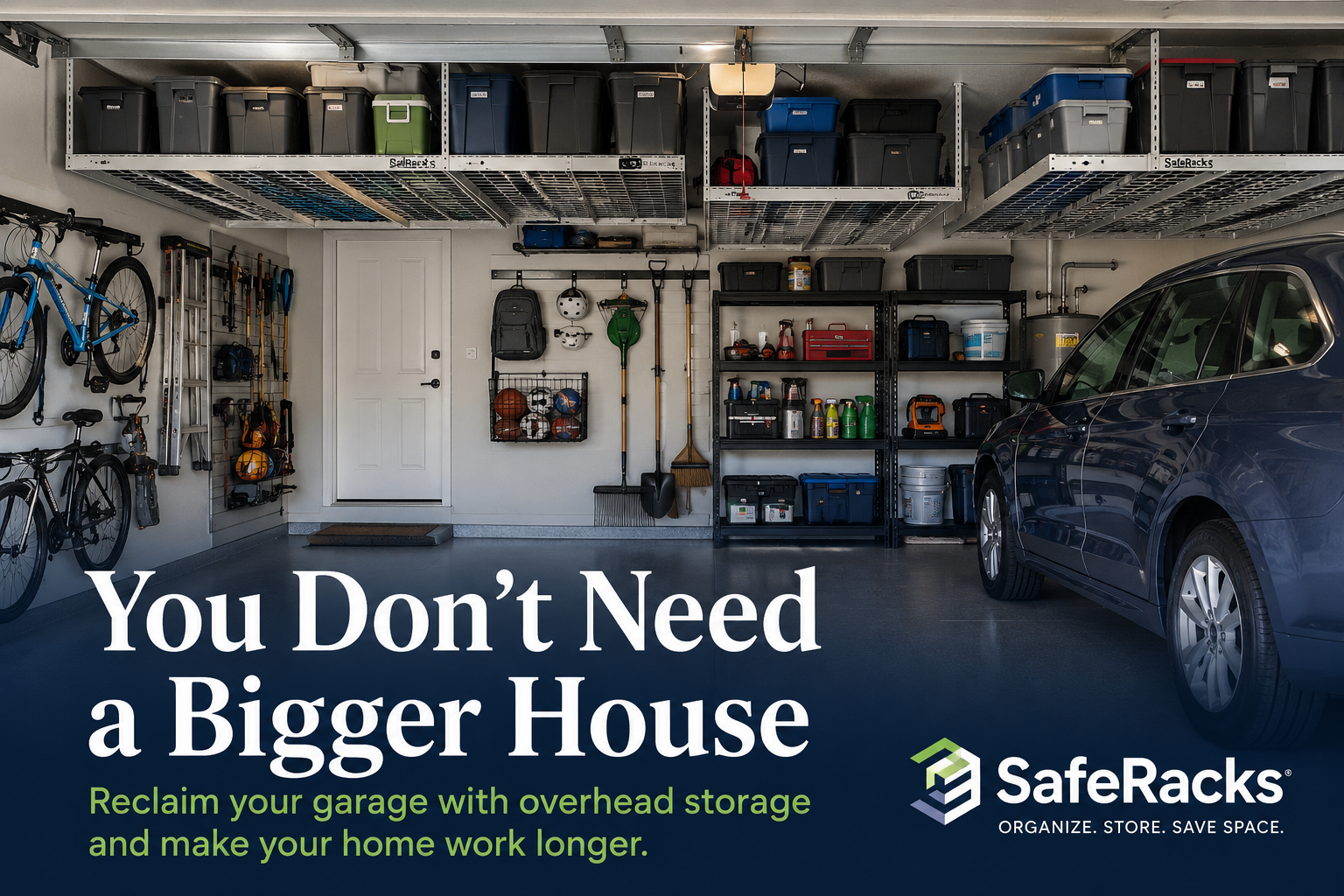
They did not move. They spent a weekend sorting, donated three carloads to the local thrift store, threw away the broken stuff, and brought in installers for two overhead racks. They added wall hooks for the bikes, a slat wall for the kids' sports gear, and a row of shelving along the back for tools and bins.
The cars went back inside on a Tuesday afternoon. Nobody scraped a windshield that winter. The kids have a system for their own gear. The lawn mower has a spot. The holiday bins live overhead and come down once a year.
The house is the same size it has always been. The family is not. But the home works again, and the question of moving has quietly moved off the kitchen table.
This is what most families are actually looking for. Not perfection. Not a magazine spread. Just a home that keeps up with the life happening inside it.
A Few More Years in the Home … That Already Feels Like Home
Reclaiming a garage will not solve every space problem in a growing family's life. But it solves more than most people expect, and it costs a tiny fraction of what moving costs.
For homeowners who are tired of parking outside, tired of stepping over bins, and tired of feeling like the only answer is a bigger house, a better-organized garage is usually the first thing worth trying.
SafeRacks builds overhead storage systems, shelving, and full garage organization solutions, and works with a national network of professional installers for homeowners who want the job done right the first time. Anyone trying to get more out of the home they already have can take a look at what is available and what installation looks like in their area. The garage is almost always where the easiest wins are hiding.
|
Solution |
Best For |
Key Limitation |
|
Overhead ceiling racks |
Seasonal/bulky items |
Ladder access required |
|
Wall slatwall/French cleats |
Tools, gear, frequent access |
Limited by wall availability |
|
Pegboard |
Hand tools, hardware |
Weight limits per hook |
|
Freestanding shelving |
Flexibility, lower cost |
Uses floor space |
|
Enclosed cabinets |
Hazardous materials, aesthetics |
Higher cost |
|
Bike hoists |
Single or few bikes |
Per-unit installation |
|
Kayak/canoe cradles |
Large watercraft |
Ceiling height required |
|
Fold-down workbench |
Occasional workspace |
Not suitable for heavy continuous use |
Putting It Together: There's No Single Right Answer
The garages that work best are almost always the ones that layer solutions: overhead racks for seasonal bulk, wall systems for tools and sporting equipment, enclosed cabinets for hazardous materials, and a zoned floor plan that protects vehicle parking.
No single product category solves a garage. A set of beautiful cabinets won't help if the ceiling is holding nothing. Overhead racks won't help if the floor is still overwhelmed with gear that needs better categorization.
The sequence matters too: declutter first, then plan zones, then choose storage solutions to serve each zone. Buying storage before you've sorted what you're keeping is one of the most common mistakes homeowners make, and one of the most expensive.
For homeowners looking to start with the solution that returns the most new space per dollar, overhead ceiling racks are consistently among the strongest choices. Systems like SafeRacks, with adjustable height, high weight capacity, and professional installation available in 40-plus cities, are built specifically for this: turning the empty ceiling zone above your cars into 100-plus cubic feet of usable storage without touching a single square foot of floor.
But the ceiling is just one layer. Build the full system, and you'll have a garage that actually works, not just one that looks organized until the next rainy weekend.