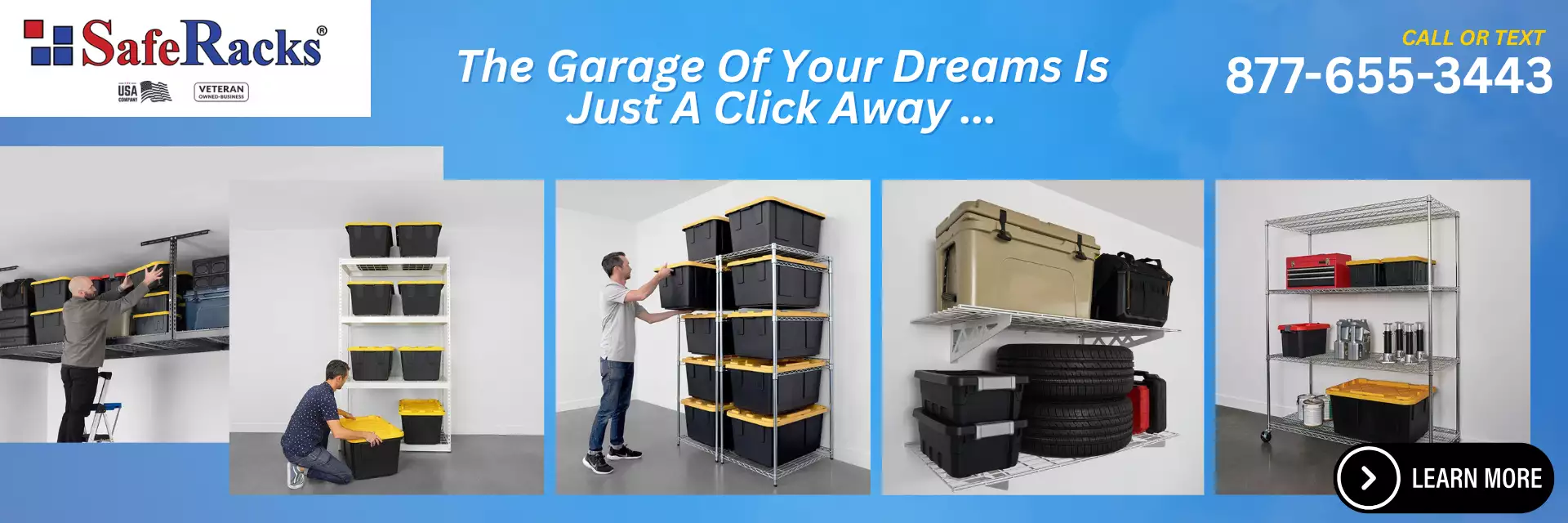
Most garages have far more usable space than homeowners realize. By combining overhead storage, wall systems, and smart layout planning, you can dramatically increase storage capacity without expanding your garage; often doubling usable space with the right approach.
10 Practical Ways to Get More Usable Space Out of Your Garage
How to Design a Garage Storage System That Actually Works Together
The average two-car garage offers between 400 and 500 square feet of floor space, plus several hundred cubic feet of vertical space above head height that most homeowners never use. The ceiling is storage. The walls are storage. The back corners are storage. The opportunity is already there … it just takes a deliberate system to unlock it.
This guide walks through how to do that practically: what to consider before choosing any hardware, what every major storage category is actually good for, and how to layer different systems so the whole garage works together. Products like SafeRacks exist specifically to help homeowners tap into that overhead zone, but overhead storage is just one piece of a larger picture.
Start With What You're Actually Keeping
The most important step before buying or installing anything is knowing what you're working with. A well-designed system built around the right inventory will serve you far better than an expensive one built around things you no longer need.
Most garages hold a mix of current gear, seasonal items, and things that have simply accumulated over time. Going through that inventory before you plan your layout gives you a clearer picture of what actually needs a home, and how much of it there is. Holiday decorations, camping gear, emergency supplies, sports equipment used a few times a year: those things earn their square footage. Everything else is worth evaluating honestly.
Once you know what you're keeping, you'll also have a better sense of categories, volume, and weight; all of which matter when choosing the right storage systems. It also often makes you think about what you genuinely should keep and what you should toss.
Understand Your Garage's Physical Constraints First
Every garage has a different set of structural and spatial variables, and the best storage layout for yours starts with understanding them.
Ceiling height determines how much overhead potential you have. A standard 8-foot ceiling still works for overhead storage, but you'll need to account for at least 6 inches of clearance below the roofline of any vehicle you park there, plus comfortable access to whatever goes up top. A 10- or 12-foot ceiling (which is more common) offers significantly more flexibility.
Layout and wall space vary more than most people expect. Garage doors, windows, electrical panels, and water heaters all take up usable wall space. The back wall is typically the most open, followed by the side walls. Getting a clear picture of your actual available wall space helps you allocate it intelligently before committing to any hardware.
Structural attachment points matter for anything you mount. Overhead systems attach to ceiling joists, typically spaced 16 or 24 inches apart. Wall-mounted systems need to be mounted to studs at a similar spacing. Neither drywall nor sheathing alone will support meaningful weight, so knowing where your framing runs is a practical first step.
Access frequency shapes where things should live. Items you reach for every week belong at eye level or below. Seasonal gear (holiday bins, camping equipment, sports items used a few times a year) is a natural candidate for overhead or high-wall storage. Getting this tier structure right means you rarely have to move one thing to reach another.
Overhead Storage
The space above your parked car is typically the most underused real estate in the entire garage. In a standard two-car garage, that zone can represent 100 to 200 square feet of horizontal storage area, entirely separate from your walls and floor.
The standard form is a platform-style rack: a steel grid suspended from the ceiling on adjustable drop rods. Most systems are modular, starting around 4×8 feet and scalable up from there. Weight ratings vary. Entry-level racks typically hold 250 to 300 pounds total, while heavy-duty units handle 600 pounds or more. The quality of the steel and the ceiling attachment method account for most of that difference.
Overhead storage is well-suited for bins, totes, and boxed items with predictable dimensions, such as holiday decorations, camping gear, off-season sports equipment, and spare supplies. The format rewards anything that can be containerized and labeled.
The honest trade-off is access. Retrieving something from overhead height requires a stable ladder and a little planning, which makes this tier best suited to things you don't reach for every week. For seasonal items, that trade-off is easy to accept.
Where overhead storage has a particular advantage is that it occupies space no other system can; directly above the vehicle footprint, where no wall shelf or freestanding unit could ever go.
Wall-Mounted Systems
Wall-mounted storage is one of the most versatile categories available, and for garages where floor space is at a premium, it's often where the biggest wins come from.
The most flexible configuration is a track-and-bracket system: horizontal metal rails anchor to wall studs, and a variety of hooks, shelves, bins, and baskets clip on. This lets you reconfigure the layout over time without creating new holes in the wall whenever your needs shift.
Track systems handle tools, sports equipment, yard care gear, and irregularly shaped items especially well; bikes, rakes, garden hoses, and extension ladders. Items stay visible, accessible, and off the floor without requiring you to open a door or lift a lid.
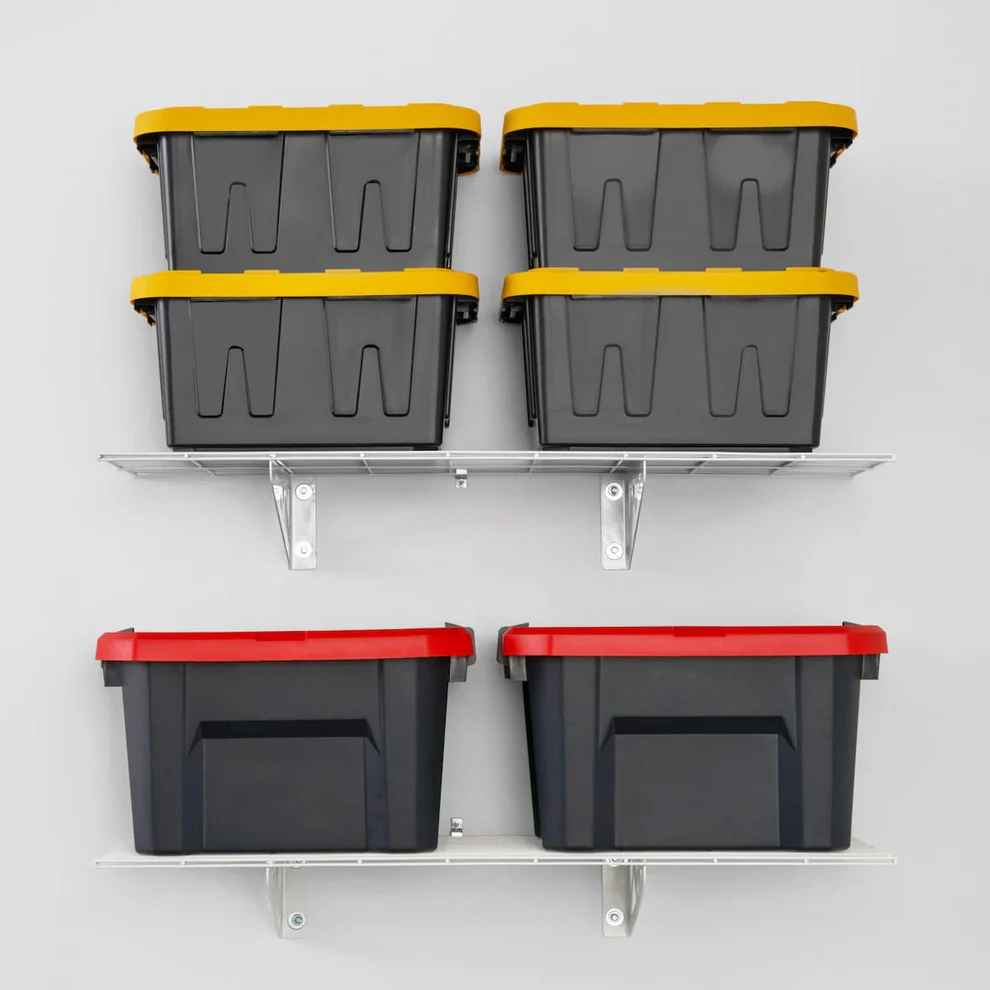
Fixed wall shelving trades flexibility for load capacity. Brackets anchored directly to studs can support several hundred pounds per shelf, making them a solid choice for automotive fluids, toolboxes, paint cans, and other dense items.
The practical constraint to plan around is that not all wall space is equal. Windows, panels, and doorways interrupt the available surface. Taking stock of what you actually have to work with before selecting a system saves a lot of measuring later.
Freestanding Shelving
Freestanding metal shelving is among the most straightforward storage solutions available. Units bolt together, stand on their own, and require no drilling into walls or ceilings, making them easy to reposition and add as needs grow.
Wire shelving allows airflow and makes it easy to see what's stored at each level. Solid steel shelving handles higher weights per shelf and is better suited for dense, heavy items. Most residential-grade units support 150 to 250 pounds per shelf; commercial-grade units go higher.
Freestanding shelving works particularly well along the back wall of a garage, or anywhere you have a run of open wall that isn't being used for anything else. It stacks a lot of storage capacity into a relatively small footprint.
One practical note for garages in areas prone to even minor flooding: the bottom shelf sits close to the floor. Storing anything moisture-sensitive there is worth thinking through, or the lowest shelf can simply stay empty as a buffer.
Cabinets
Enclosed garage cabinets offer a different value proposition than open shelving: protection. Steel cabinets keep contents clean, dust-free, and out of reach of children or pets. They also give the garage a cleaner visual profile, which matters in garages that double as a workshop, home gym, or extended living space.
Cabinets are a good fit for power tools, chemicals, paints, and anything worth protecting from humidity or damage. For homeowners who want a garage that looks organized rather than just functional, cabinets carry much of that aesthetic.
The trade-off is cost and flexibility. Cabinets represent a significantly higher investment per square foot of storage than most other options, and they don't accommodate irregular or oversized items easily. They work best as one component of a larger system, handling specific categories rather than carrying the whole organizational load.
Pegboards and Tool-Specific Systems
For any garage with a workshop element, pegboard or slatwall is hard to beat for storing hand tools and shop supplies. A 4×8 sheet with a good hook set puts an enormous variety of tools in plain sight and within easy reach; no digging through drawers or opening cabinet doors.
Slatwall panels are more durable and accept heavier accessories, making them worth the added cost for serious shop use. Both systems require dedicated wall space, so the decision comes down to whether your garage has that space available and how much workshop activity it sees.
In a garage used purely for storage with no workshop function, these systems are less relevant. In a garage where someone actually works on projects regularly, they make a noticeable difference in how that space functions day to day.
Ceiling Lifts and Specialty Systems
Motorized ceiling lifts (pulley-and-cable systems controlled by a switch or remote) address the one real limitation of fixed overhead storage: the effort required to get things down. They're most commonly used for bikes, kayaks, canoes, and other large, awkward items that are impractical to lift manually.
Single-item hoists for bikes or kayaks are a simpler and far less expensive version of the same idea. For a household with one or two bikes and limited floor or wall space, a ceiling hoist is often the most elegant solution available.
These are purpose-built tools for specific problems. They're not meant to be a primary storage system, but for the right items, they free up significant floor or wall space that can then be put to better use.
Workbench Considerations
A workbench earns its floor space when it's actually used for projects. The question isn't really whether to have one, but how to size it and configure it so it contributes to the garage's storage capacity rather than simply taking from it.
A fold-down wall-mounted bench is worth considering in garages where floor space is tight and the bench gets used occasionally rather than daily. When folded, it frees up the full width of the wall for other uses. The trade-off is reduced stability under heavy loads and no storage underneath.
A fixed bench should incorporate its own storage: drawers, pegboard or slatwall mounted directly above, shelves or cabinets beneath. Every square foot a workbench occupies is worth making do double duty.
Zoning: How It All Fits Together
A garage works better when different areas are intentionally assigned to different functions, and when the storage choices within each zone match how that area gets used.
A workable model for a two-car garage: the front third, near the door, stays clear for vehicle access and daily-use items. The back third becomes the primary storage zone; freestanding shelving along the back wall, cabinets for protected items, a workbench if the space supports one. Overhead racks span the middle third above the parked vehicles. Wall systems in the storage zone handle tools and sports equipment based on what's actually stored there.
The goal of zoning isn't rigid separation … it's making sure every area has a purpose before hardware goes up, so the layout serves the way the garage actually gets used.
Why Combining Systems Is What Actually Works
The garages that function well aren't the ones with the most hardware. They're the ones where each type of storage is doing the work it's actually suited for.
Overhead racks handle seasonal, binnable items that don't need frequent access. Wall systems handle tools, sports gear, and anything that benefits from being visible and accessible. Freestanding shelving or cabinets manage dense, heavy, or protected items at standing height. Specialty hardware solves for bikes and oversized gear that doesn't fit neatly into any other category.
None of those systems is a complete answer on its own. Together, they cover all the variables a real garage presents.
SafeRacks represents what the overhead storage category looks like when it's done well: heavy-duty steel, meaningful weight capacity, and professional installation available for homeowners who want it handled properly. But it's one layer in a system, not a substitute for thinking through the whole picture.
The good news is that most garages already have far more usable space than they're currently using. The ceiling and the walls are waiting. A little planning and the right combination of systems is usually all it takes to put them to work.
|
Solution |
Best For |
Key Limitation |
|
Overhead ceiling racks |
Seasonal/bulky items |
Ladder access required |
|
Wall slatwall/French cleats |
Tools, gear, frequent access |
Limited by wall availability |
|
Pegboard |
Hand tools, hardware |
Weight limits per hook |
|
Freestanding shelving |
Flexibility, lower cost |
Uses floor space |
|
Enclosed cabinets |
Hazardous materials, aesthetics |
Higher cost |
|
Bike hoists |
Single or few bikes |
Per-unit installation |
|
Kayak/canoe cradles |
Large watercraft |
Ceiling height required |
|
Fold-down workbench |
Occasional workspace |
Not suitable for heavy continuous use |
Putting It Together: There's No Single Right Answer
The garages that work best are almost always the ones that layer solutions: overhead racks for seasonal bulk, wall systems for tools and sporting equipment, enclosed cabinets for hazardous materials, and a zoned floor plan that protects vehicle parking.
No single product category solves a garage. A set of beautiful cabinets won't help if the ceiling is holding nothing. Overhead racks won't help if the floor is still overwhelmed with gear that needs better categorization.
The sequence matters too: declutter first, then plan zones, then choose storage solutions to serve each zone. Buying storage before you've sorted what you're keeping is one of the most common mistakes homeowners make, and one of the most expensive.
For homeowners looking to start with the solution that returns the most new space per dollar, overhead ceiling racks are consistently among the strongest choices. Systems like SafeRacks, with adjustable height, high weight capacity, and professional installation available in 40-plus cities, are built specifically for this: turning the empty ceiling zone above your cars into 100-plus cubic feet of usable storage without touching a single square foot of floor.
But the ceiling is just one layer. Build the full system, and you'll have a garage that actually works, not just one that looks organized until the next rainy weekend.