As more families share one home with aging parents, adult children, and growing households, staying organized has become more important than ever. Learn practical ways to reduce clutter, maximize unused space, and create a home that feels comfortable for everyone. From garage overhead storage to pantry shelving and closet organization, discover how thoughtful storage solutions from SafeRacks can help multigenerational homes function better without expensive renovations or moving.
7 Smart Ways to Make a Multigenerational Home Feel More Spacious
Making One House Work for Every Generation
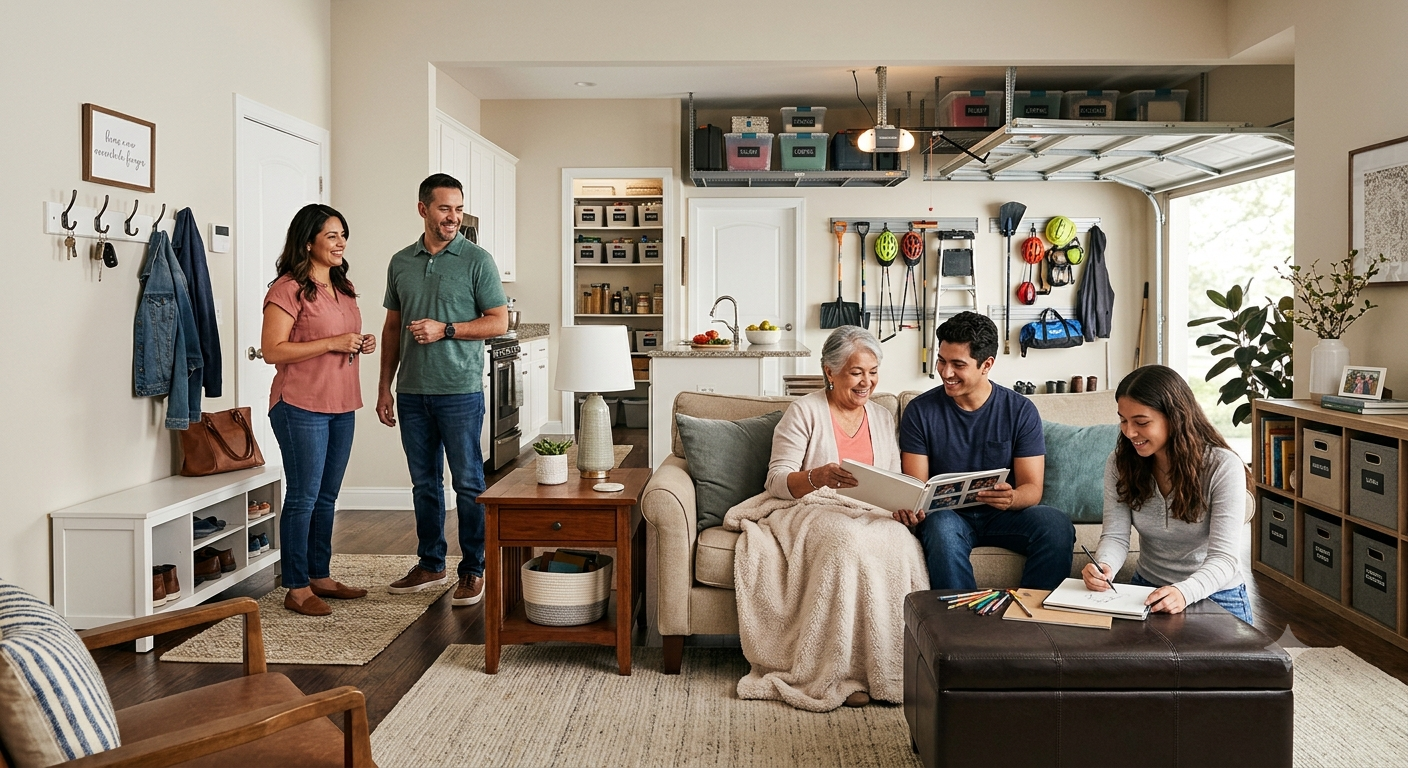
When Elena moved in with her daughter, Marisol, last spring, the Alvarez house did not suddenly get smaller. It just started to feel that way. Marisol and her husband, Tom, had a comfortable four-bedroom home, but between the two of them, their teenage daughter, Elena's furniture and keepsakes, and their 24-year-old son, who had moved back after college to save money, the same rooms that once felt roomy now felt like they were closing in. Multi-Generational homes are no longer an anomaly.
If that sounds familiar, you are in very good company, and the good news is that the problem is usually more solvable than it looks. This is where thoughtful organization matters more than square footage, and where a company like SafeRacks fits in. Most people first hear about SafeRacks through its overhead garage storage racks, but the company helps homeowners make far better use of the space they already have throughout the whole house. Its product line extends well beyond the garage into shelving, wall storage, workbenches, hooks, and other organization solutions for pantries, mudrooms, utility rooms, workshops, laundry rooms, and closets. The goal is not to talk you into more stuff. It is to help the space you already own do more for the people living in it.
Let's walk through the questions families like the Alvarez’s are actually asking.
Why are more families living together today?
Multigenerational living is not a throwback or an oddity. It is one of the fastest-growing ways Americans live. The number of people in multigenerational family households quadrupled between 1971 and 2021, reaching 59.7 million people, or about 18% of the U.S. population. More recently, multigenerational homes made up 17% of all home purchases in 2024, a record for the segment.
A few forces are driving this, and none of them are unusual.
Housing costs are the big one. Cost savings was the single most common reason buyers gave for choosing a multigenerational home in 2024, cited by 36% of them. Sharing a mortgage, utilities, and groceries simply stretches further than paying for two households.
Adult children are staying home longer, or coming back. In 2024, 21% of buyers pointed to an adult child moving back home, up from 11% in 2015, and 20% said their adult children had never left, up from just 7% a decade earlier. Delayed homeownership, student debt, and a tough rental market all play a part.
Caregiving is another. Many families in the middle, often called the sandwich generation, are raising kids and supporting aging parents at the same time. Among Gen Xers who care for their parents, half also have a child under 18 at home.
And people are living longer. Roughly 75% of adults 50 and older say they want to stay in their own homes as they age, and moving in with family is often how that happens with dignity and support close by.
Put simply, this is a normal, increasingly common, and often smart way to live. The challenge is rarely the decision to live together. It is making the house feel good once everyone is under one roof.
Why does a home start feeling crowded?
Here is the part that surprises people: the house is usually not too small. The belongings are just too many, and too poorly organized.
When generations combine, so do their possessions. Two kitchens become one, which means duplicate pots, small appliances, mixing bowls, and coffee makers. Holiday decorations double. Hobbies pile up, from sewing supplies to woodworking tools to fishing gear. Sports equipment multiplies with every kid and grandkid. Then come the keepsakes, the boxes of photos, the heirloom furniture nobody wants to part with, and the everyday necessities every person needs within reach.
The typical multigenerational household consists of about five people sharing a four-bedroom home. That is a lot of life in one footprint.
None of this is a failure. It is just physics. When belongings accumulate faster than a home has designated places to put them, those items spill into living space. The dining table becomes a landing zone. The guest room becomes storage. The garage stops holding cars. Slowly, the home feels crowded, even though the walls never moved.
The fix is not getting rid of everyone's things. It is giving every category of belongings a clear, intentional home so it stops competing with the people.
Which spaces in a home are usually underused?
Most homes hide a surprising amount of storage in plain sight. The Alvarez family found theirs the same way most families do: by looking up and taking a look at the rooms they had written off.
The garage is almost always the biggest opportunity. In many homes, the floor is cluttered while the ceiling, the single largest unused surface in the house, sits completely empty. Overhead racks change that overnight. A Safe Racks overhead rack can add up to 120 cubic feet of storage per rack, holding up to 600 pounds on 14-gauge steel, all bolted safely above head height where nobody walks. Seasonal bins, holiday decorations, camping gear, and luggage go up top, and the floor comes back.
But the garage is only the start. Consider the vertical space in these often-overlooked rooms:
The pantry, where tall wall-mounted shelving turns wasted upper wall into real capacity for the extra dry goods a bigger household goes through.
The laundry room and utility room, where a few sturdy shelves get supplies off the floor and machines breathe.
The mudroom, where hooks and a compact bench give every person a landing spot for shoes, coats, and bags so the entryway stops becoming a pile.
Closets, where a single added shelf or a second rod can double what a closet holds.
The workshop or basement, where all-steel shelving handles tools, paint, and bulk storage. One honest note worth knowing: shelving with MDF or particleboard decks tends to warp over time in damp basements and laundry areas, while all-steel and wire-grid shelving holds up in the same conditions. In a home where storage needs to last for years, that difference matters.
The theme across every one of these spaces is the same. Building up and out into space you already own is dramatically cheaper than remodeling or moving, and it usually solves more of the problem than people expect.
What should stay within easy reach, and what can be stored?
Once you have more usable space, the next question is what goes where. This is where a simple habit makes daily life noticeably calmer: sort belongings by how often they are actually used, not by how much they matter.
Ask one question about any item. Do we use this weekly, seasonally, or rarely?
Weekly items belong at eye level and within arm's reach. Everyday dishes, current-season coats, school and work bags, the tools you grab constantly, and anything a grandparent needs to reach without bending or climbing. Accessibility here is not a luxury. In a home with older adults, keeping daily items low and reachable is a genuine safety measure.
Seasonal items belong in a middle zone that is organized but a step out of the way. Think holiday decorations, winter gear in summer, camping equipment, and the roasting pan you only use for big gatherings. Clear labeled bins on garage shelves or overhead racks are perfect for this.
Rarely used items belong up high or deep in long-term storage. Keepsakes, archived paperwork, baby items being saved for grandchildren, and heirlooms you are keeping but not displaying. Overhead racks and high shelving were made for exactly this.
For the Alvarez family, this one shift did more than anything else. Elena's everyday medications and mixing bowls stayed low in the kitchen. Her holiday china went up on a garage rack. The son's college boxes went overhead until he needed them. Nobody lost anything. Everything just stopped being underfoot.
How can every generation share a home more comfortably?
Living well together is partly logistics and partly respect. The families who do it best tend to lean on a handful of simple systems.
Assign storage zones. Give each person or household unit their own clearly defined space, a set of shelves, a section of the garage, a labeled closet. When people know what is theirs, the low-grade friction of shared space drops fast. Elena has her own shelving unit in the garage for her things, and that small boundary prevents a lot of quiet resentment.
Label everything. In a busy household, a labeled bin is the difference between calm and chaos. Labels also stop people from opening five boxes to find one thing, and they make it obvious where an item returns.
Reduce duplicate purchases. When storage is organized and visible, families stop buying second and third versions of things they already own but could not find. That saves money and space at the same time.
Create designated family spaces. Alongside personal zones, protect a few shared, uncluttered areas, the living room, the dining table, a den, where the whole household actually gathers. Keeping those spaces clear is easier when everything else has a proper home.
Keep frequently used items accessible while long-term storage stays out of the way. This is the heart of it. The daily stuff stays reachable and visible. The rarely-used stuff goes up, back, and organized, so it is there when needed but never in the way. Wall storage, hooks, workbenches, and overhead racks each play a role in keeping that balance.
When does it make sense to improve storage instead of adding more space?
When a home feels tight, the instinct is often to think big: build an addition, add an in-law suite, rent a storage unit, or sell and buy something larger. Sometimes those moves are the right call. Often, though, better organization solves most of the problem for a small fraction of the cost.
Look at the numbers honestly.
An accessory dwelling unit, the in-law suite or granny flat many multigenerational families consider, averages around $180,000, with most projects landing between roughly $40,000 and $360,000. Even the budget path is not cheap. Converting a basement into a small living space commonly runs $30,000 to $60,000, and a garage conversion often starts around $20,000 and climbs from there.
Moving up in size is its own expense. The median list price for a multigenerational home in 2025 was about $709,000, roughly 65% higher than the $429,900 median for a standard listing, before you count agent fees, moving costs, and the stress of uprooting the whole family. Newsweek
A storage unit seems small by comparison, but it adds up and never stops. A standard 10-by-10 unit averages around $119 a month nationally. Over three years that is more than $4,000, and your belongings are sitting in a building you have to drive to. Bearcavestorage
Now compare that to organizing the space you already have. A full set of overhead racks, shelving, wall storage, and hooks is a one-time cost measured in the hundreds to low thousands, it stays in your home, and it comes with a Limited Lifetime Warranty on core SafeRacks products. For most families, thoughtfully organizing the garage, pantry, closets, and utility rooms recovers enough usable space to make an addition or a move unnecessary, and it makes the house easier to live in every single day in the meantime.
The rule of thumb is simple. Before you spend tens of thousands adding space, find out how much space you already have and are not using. For a lot of households, that discovery ends the conversation.
Making a shared home feel like home
Every family's situation is different. Some are welcoming a parent for the long term. Some are giving an adult child a soft place to land. Some are simply making one house work for more people than it was built for. There is no single right way to do it.
What they share is a goal that has nothing to do with storing more stuff. It is about creating a home that feels calmer, works better, and is more enjoyable for everyone in it. When the daily things are easy to reach, the seasonal things are organized, and the rarely-used things are tucked safely out of the way, a full house stops feeling crowded and starts feeling like it holds everyone comfortably. That is what the Alvarez family found. The house never got bigger. It just started working.
If you are looking for practical ways to get there, SafeRacks offers durable storage and organization solutions for the garage and well beyond it, shelving, wall storage, workbenches, hooks, and more, designed to help families make the most of the space they already have and to adapt as their needs change over time. Sometimes a more comfortable home is not about finding more room. It is about finally using the room you have.
|
Solution |
Best For |
Key Limitation |
|
Overhead ceiling racks |
Seasonal/bulky items |
Ladder access required |
|
Wall slatwall/French cleats |
Tools, gear, frequent access |
Limited by wall availability |
|
Pegboard |
Hand tools, hardware |
Weight limits per hook |
|
Freestanding shelving |
Flexibility, lower cost |
Uses floor space |
|
Enclosed cabinets |
Hazardous materials, aesthetics |
Higher cost |
|
Bike hoists |
Single or few bikes |
Per-unit installation |
|
Kayak/canoe cradles |
Large watercraft |
Ceiling height required |
|
Fold-down workbench |
Occasional workspace |
Not suitable for heavy continuous use |
Putting It Together: There's No Single Right Answer
The garages that work best are almost always the ones that layer solutions: overhead racks for seasonal bulk, wall systems for tools and sporting equipment, enclosed cabinets for hazardous materials, and a zoned floor plan that protects vehicle parking.
No single product category solves a garage. A set of beautiful cabinets won't help if the ceiling is holding nothing. Overhead racks won't help if the floor is still overwhelmed with gear that needs better categorization.
The sequence matters too: declutter first, then plan zones, then choose storage solutions to serve each zone. Buying storage before you've sorted what you're keeping is one of the most common mistakes homeowners make, and one of the most expensive.
For homeowners looking to start with the solution that returns the most new space per dollar, overhead ceiling racks are consistently among the strongest choices. Systems like SafeRacks, with adjustable height, high weight capacity, and professional installation available in 40-plus cities, are built specifically for this: turning the empty ceiling zone above your cars into 100-plus cubic feet of usable storage without touching a single square foot of floor.
But the ceiling is just one layer. Build the full system, and you'll have a garage that actually works, not just one that looks organized until the next rainy weekend.