Before spending thousands on an addition or remodeling project, consider whether your home already has the storage space you need. This guide explains how to maximize garages, basements, closets, utility rooms, and other overlooked areas using smart organization and vertical storage. Learn practical ways to create more usable space, reduce clutter, and improve your home's functionality without the expense and disruption of major renovations.
Most homes have unused wall and ceiling space that can dramatically increase storage without adding square footage.
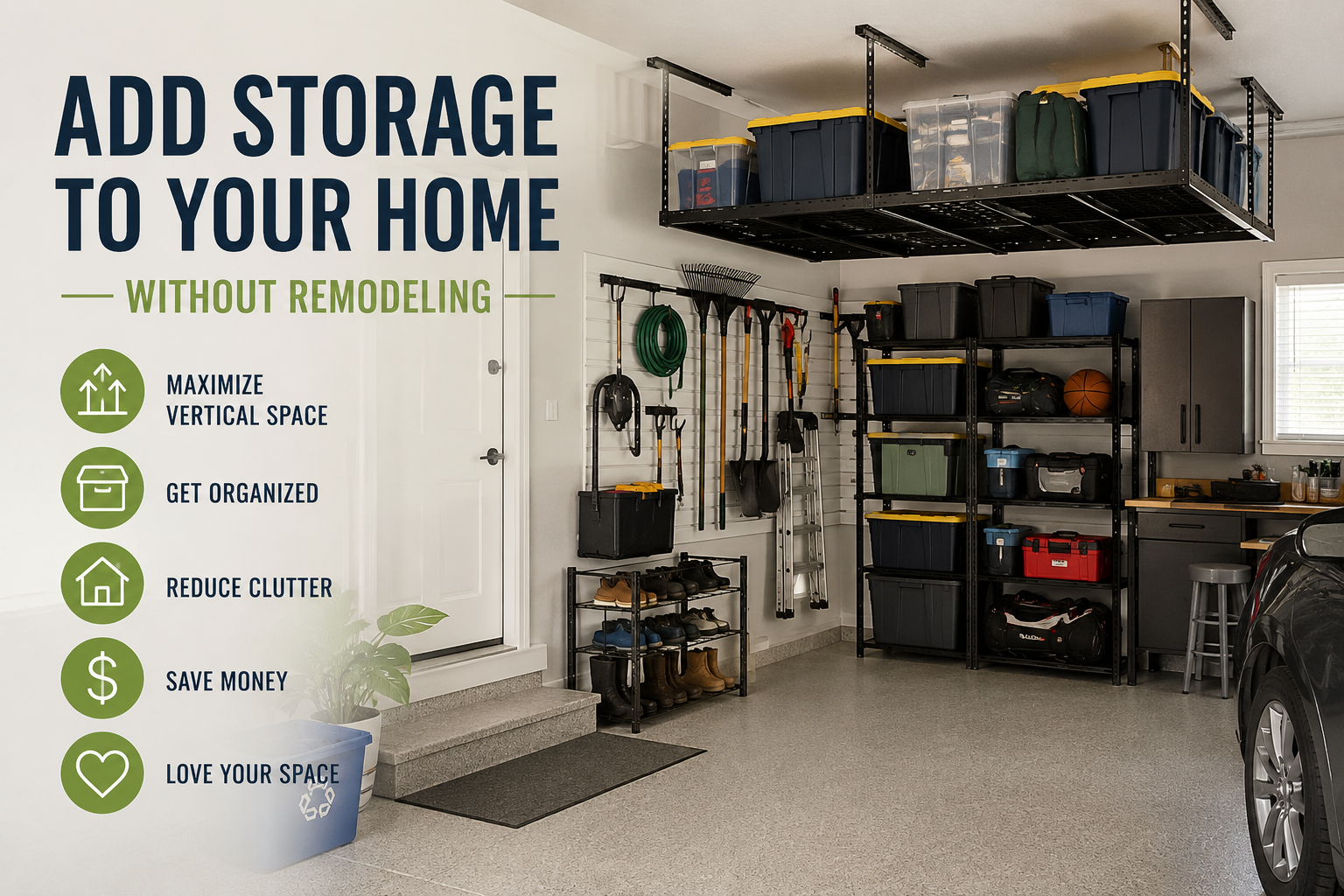
The garage usually offers the biggest opportunity for reclaimed storage through overhead racks, shelving, and wall-mounted systems.
Basements, laundry rooms, closets, pantries, and utility rooms often have empty space above eye level that's ready to be put to work.
A home feels cluttered when belongings don't have designated storage. Organization often solves problems that square footage cannot.
Keep everyday items within easy reach while storing seasonal and infrequently used items overhead or in less accessible locations.
Adjustable shelving, modular racks, and movable accessories can adapt as your family's needs change over time.
Steel shelving and wire systems perform better in damp basements, while open shelving often provides greater flexibility than cabinets.
Simple storage upgrades often deliver more usable space for hundreds of dollars instead of the tens of thousands required for additions or finished basements.
Keep holiday decorations, camping gear, sports equipment, and hobby supplies grouped together so they're easier to find and store.
Your storage needs will change over time. Choosing adaptable storage solutions helps your home stay organized for years without another major investment.
Most homes already hold the space you need. Here is how to find it and put it to work without renovating.
When a house starts to feel tight, the mind jumps straight to the big fixes. Build an addition. Finish the basement. Rent a unit across town. Drop a shed in the backyard.
Those options work. They also cost a lot, take months, and turn your home into a construction site while they're underway.
Here is the part most homeowners miss. A lot of homes are not actually short on space. They are short on a system for using the space they already have.
That is the gap SafeRacks has spent years helping people close. The company designs home storage solutions for garages, basements, utility rooms, pantries, and workshops, and thousands of households have used those systems to get more out of rooms they already own, without pouring a foundation or signing a lease.
This article is about that approach. Not a sales pitch, just a clearer way to look at the square footage already sitting around you.
Walk through most homes and you will notice the same thing. The floors are crowded and the air above them is empty.
Bins stack in corners. Boxes line the garage walls. Closets are packed at eye level and bare up top. Meanwhile the space from your shoulders to the ceiling, in almost every room, holds nothing at all.
A house feels small when everything competes for the same flat surfaces. It feels bigger the moment things start moving up and off the floor.
The other reason homes feel cramped is simpler. A lot of stuff has no assigned home, so it lands wherever there is an open spot. That is not a square footage problem. That is an organization problem, and organization problems are far cheaper to solve.
Before you price out a renovation, it helps to take inventory of the storage you already have but are not really using.
Garages are the obvious one, and the biggest opportunity, so we will come back to them. But the list is longer than people expect. Utility rooms have wall and ceiling space sitting empty above the water heater and furnace. Basements often run wall to wall in unused vertical room. Pantries waste the gap between shelves. Laundry rooms have bare walls over the machines. Closets stop at one rod and one shelf when they could hold three. Mudrooms collect clutter that better systems could contain.
None of that requires construction. It requires looking at each room and asking what the walls and ceilings could be doing that they currently are not.
Start With the Garage, Because That Is the Biggest Win
If you only fix one room, make it the garage. No other space in a typical home holds this much wasted potential, and the payoff shows up fast.
The single most overlooked storage area in any house is the garage ceiling. It is wide open, structurally strong, and doing nothing.
Overhead garage storage is built for exactly this. A ceiling-mounted rack lifts the heavy, bulky, seasonal items off your floor and parks them above the cars, keeping them out of the way until you need them.
SafeRacks overhead racks are made from 14-gauge steel and a single 4x8 unit holds up to 600 pounds and roughly 120 cubic feet. That is a full season of holiday decorations, a bin wall of camping gear, and the luggage set, all overhead, none of it on the ground. The height adjusts so you can clear the garage door track and the cars below.
Reclaim that ceiling and the floor opens up underneath it. For a lot of families, that is the difference between parking in the garage and parking in the driveway.
Cabinets look clean, but they are expensive, they hide what is inside, and they lock you into one layout. For most garages, open garage shelving does more work for less money.
Freestanding steel shelving gives you visibility and flexibility. You can see what you own, grab it without digging, and rearrange the whole thing in an afternoon when your needs change. SafeRacks freestanding units hold up to 500 pounds per shelf and 2,000 pounds total, which is enough for tools, paint, bulk supplies, and the heavy odds and ends a garage accumulates.
Cabinets make sense when you want to hide clutter or lock away chemicals and valuables. For raw capacity and day to day access, shelving usually wins.
The wall between floor and ceiling is the third zone, and it is perfect for the things that never fit neatly in a bin. Wall-mounted systems and accessory hooks get bikes, ladders, hoses, rakes, and sports equipment off the floor and onto vertical real estate you were not using.
Stack all three zones, ceiling, walls, and shelving, and a cluttered garage turns into one of the most functional rooms in the house.
The same logic carries through the rest of the home. Find the empty vertical space, then give it a job.
Basements are storage gold when they are dry. Tall shelving along the walls turns a damp catch-all into organized basement storage for archives, off-season clothes, and keepsakes. One honest note worth knowing: MDF-deck shelving can swell in humid spaces, so in a basement that runs damp, all-steel or wire-grid shelving holds up far better over time. It is the kind of detail that saves you a warped shelf two years from now.
Laundry and utility rooms have bare walls above the machines and around the mechanicals. A few shelves there clear the countertop and the floor at once.
Pantries lose space in the air between fixed shelves. Adjustable shelving and a couple of stackable tiers can roughly double what a pantry holds without touching the footprint.
Closets and mudrooms are usually built out to a fraction of their capacity. A second rod, a top shelf, and a few bins reshape a closet completely. In the mudroom, hooks and cubbies give the daily pile of shoes and bags somewhere to actually land.
Once you have the storage, where things go matters as much as how much you can fit.
The principle is simple. Everyday items belong at eye level and within easy reach. Things you touch a few times a year, holiday bins, camping gear, the good luggage, belong up high or out of the way. Items you rarely use but cannot part with go in the least convenient spots.
Organize by frequency of use and the space starts working for you. Reach for the snow shovel in December and it is right there. The kayak you use twice a summer rides overhead the other ten months and never blocks your path.
This is also why seasonal gear has such a natural rhythm. Holiday decorations, ski equipment, patio cushions, and camping kit all rotate in and out on a predictable schedule. Store each set together, label it, and put it overhead. Swapping seasons becomes a ten minute job instead of an afternoon of excavation. Sports equipment, tools, and hobby supplies follow the same pattern: group by activity, store by frequency, keep the active stuff reachable.
What This Actually Costs Compared to the Alternatives
Here is where the math gets persuasive. Line up the expensive fixes against simply improving the storage you have, and the gap is hard to ignore.
Now compare that to upgrading what you already own. A quality overhead rack or a run of heavy-duty shelving is a one-time cost in the low hundreds of dollars, installs in an afternoon, and keeps working for as long as you own the home. SafeRacks backs its systems with a Limited Lifetime Warranty, and for anyone who would rather not get on a ladder, a professional installer network covers 40-plus cities. You can reach it at saferacks.com/installation or 877-655-3443.
The contrast is the whole point. Tens of thousands of dollars and months of disruption, or a few hundred dollars and an afternoon to unlock space you already paid for when you bought the house.
If you want to pressure-test these numbers, remodeling cost studies, home improvement publications, and the cost-versus-value reports the industry publishes each year are all worth a look, along with professional organizers and storage planning guides who do this work for a living.
The last thing to think about is time. A growing family stores different things than empty nesters. Hobbies come and go. The gear changes.
That is the quiet advantage of good storage systems over fixed renovations. Adjustable shelving, modular racks, and reconfigurable hooks bend to whatever your household needs next year. A finished room is locked in. A flexible system is not.
Set things up so they can move, and you solve the storage problem once instead of every few years.
You Probably Do Not Need More House
Adding storage does not always mean adding square footage. Far more often, the space is already there, hiding in plain sight above your head and along your walls.
Look up before you build out. Most homes have room to spare once the ceilings, walls, and vertical space start doing their share. Thoughtful organization ideas and the right systems can change how a house functions without the cost, the mess, or the months a renovation takes.
If you are looking for practical ways to create more usable space without remodeling, it is worth seeing what SafeRacks offers. The cheapest square footage you will ever find is the kind you already own.
|
Solution |
Best For |
Key Limitation |
|
Overhead ceiling racks |
Seasonal/bulky items |
Ladder access required |
|
Wall slatwall/French cleats |
Tools, gear, frequent access |
Limited by wall availability |
|
Pegboard |
Hand tools, hardware |
Weight limits per hook |
|
Freestanding shelving |
Flexibility, lower cost |
Uses floor space |
|
Enclosed cabinets |
Hazardous materials, aesthetics |
Higher cost |
|
Bike hoists |
Single or few bikes |
Per-unit installation |
|
Kayak/canoe cradles |
Large watercraft |
Ceiling height required |
|
Fold-down workbench |
Occasional workspace |
Not suitable for heavy continuous use |
Putting It Together: There's No Single Right Answer
The garages that work best are almost always the ones that layer solutions: overhead racks for seasonal bulk, wall systems for tools and sporting equipment, enclosed cabinets for hazardous materials, and a zoned floor plan that protects vehicle parking.
No single product category solves a garage. A set of beautiful cabinets won't help if the ceiling is holding nothing. Overhead racks won't help if the floor is still overwhelmed with gear that needs better categorization.
The sequence matters too: declutter first, then plan zones, then choose storage solutions to serve each zone. Buying storage before you've sorted what you're keeping is one of the most common mistakes homeowners make, and one of the most expensive.
For homeowners looking to start with the solution that returns the most new space per dollar, overhead ceiling racks are consistently among the strongest choices. Systems like SafeRacks, with adjustable height, high weight capacity, and professional installation available in 40-plus cities, are built specifically for this: turning the empty ceiling zone above your cars into 100-plus cubic feet of usable storage without touching a single square foot of floor.
But the ceiling is just one layer. Build the full system, and you'll have a garage that actually works, not just one that looks organized until the next rainy weekend.