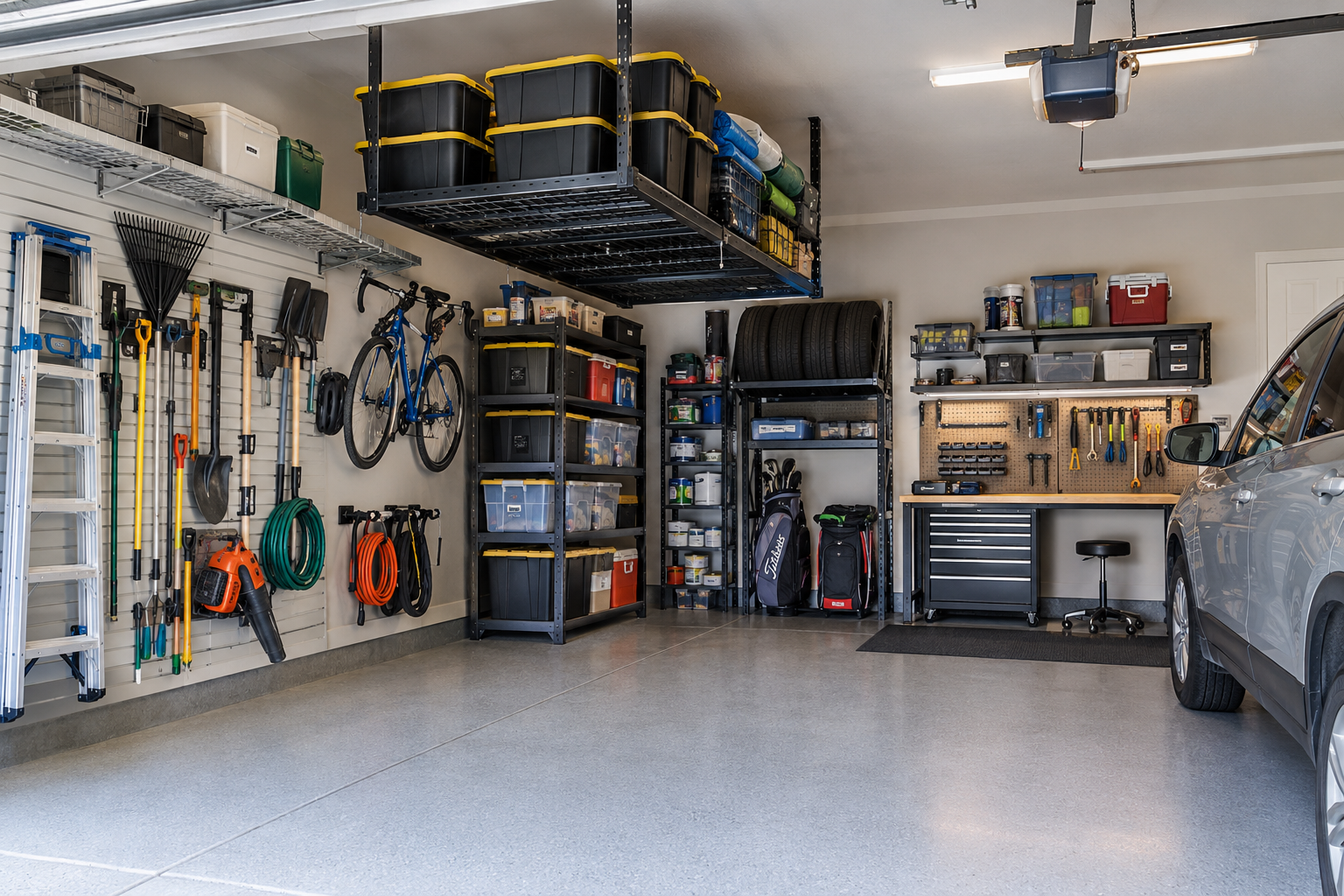
The best garage storage ideas use overlooked ceiling and wall space before sacrificing more of the floor. Overhead racks, wall-mounted shelves, hooks, bike storage, bin racks, steel shelving, and specialty organizers can make room for vehicles while keeping tools and seasonal gear accessible. SafeRacks offers storage systems that help homeowners match each type of garage clutter with a practical place to keep it.
10 Garage Storage Ideas Worth Considering
Simple storage systems most homeowners overlook, and how to know which ones fit your garage.
Most garages fill up the same way. A few boxes go in. Then the seasonal bins, the bikes, the yard tools, the sports gear. Before long, the car lives in the driveway, and the garage becomes the place you avoid.
When people finally decide to fix it, they usually reach for one of two things. A shelf, or maybe an overhead rack. Both are good. But they are only two options out of many, and the other solutions often solve problems those two cannot.
That is the real issue. Garages hold a wide mix of items, and different items need different homes. A ladder does not belong on a shelf. A set of winter tires does not belong on a hook. Seasonal totes do not belong on the floor.
This is where a company like SafeRacks comes in. SafeRacks makes overhead racks, wall shelves, freestanding shelving, wire racks, bin systems, hooks, bike storage, and specialty racks for awkward gear. Seeing the full range makes it easier to match the right system to the right stuff.
Below are 10 storage ideas worth knowing. For each one, you will find the problem it solves, what fits there, when it makes sense, and where it falls short. Very little in a garage is truly hard to store. Most of it just needs the right spot.
The floor is full. The walls fill up next. Meanwhile, the ceiling sits empty.
Overhead racks hang from the ceiling and turn that dead air into storage. They offer the biggest space gain in most garages.
They work best for bulky, lightweight, rarely used items. Holiday decorations, camping gear, luggage, and off-season bins are ideal. SafeRacks overhead racks hold up to 600 pounds and add around 120 cubic feet of storage, with an adjustable drop so you can clear a tall SUV or drop lower under a high ceiling.
The trade-off is access. You need a ladder to reach them, so they're not ideal for anything you use weekly. They also need proper mounting into ceiling joists and enough clearance above the garage door track. Low ceilings limit what you can hang.
Overhead storage handles the ceiling. Wall shelves handle the reach zone, the band of wall between about knee and shoulder height where you actually grab things.
This is the space that gets wasted most. Items pile on the floor while the wall above them stays bare.
Mounted shelves lift bins, tools, and supplies off the floor and keep them in easy view. SafeRacks wall shelves come in a two-pack rated at 250 pounds per shelf, use steel wire decks, and include deck hooks for hanging items underneath. They install in about 10 minutes.
Use them for things you reach for often. Car care products, paint, hand tools, and labeled bins all work well.
The limit is depth and weight. Shelves are shallower than freestanding units, and every bracket has to hit a stud. Skip the drywall anchors for anything heavy.
Sometimes you just need a lot of organized capacity, fast, without drilling into anything.
Freestanding shelving is the workhorse answer. It stands on its own, holds heavy loads, and can be moved or reconfigured later.
SafeRacks freestanding units hold up to 500 pounds per shelf and up to 2,000 pounds total, built from all-steel wire grid. That is enough for tools, paint, car parts, and pantry overflow on a single unit.
This is a strong choice for renters, since nothing gets attached to the structure. It is also easy to add to over time.
The catch is footprint. Freestanding shelving uses floor space, so it works against you if you place it poorly. Keep it tight against a wall. And anchor tall units at the top, because a heavily loaded shelf can tip if it is bumped.
Not all shelving survives a garage. This one is worth calling out on its own.
Many budget shelves use MDF or particleboard decks. In a humid garage, basement, or laundry area, those decks swell, warp, and eventually fail. It is one of the most common storage disappointments.
Wire shelving avoids the problem. SafeRacks wire racks are NSF-certified and zinc-plated for rust protection, and the open grid lets air move so moisture never sits. The shelves adjust in one-inch increments and can take casters if you want to roll the unit.
Store cleaning liquids, laundry supplies, pantry goods, and anything you would keep in a damp room.
The downside is the open grid itself. Small items can slip through the gaps. A thin shelf liner or a few bins solves that easily.
Fixed hooks and shelves have one weakness. Once they are mounted, they stay put, even when your needs change.
Track systems fix that. You mount a rail or track once, then clip on hooks, baskets, and small shelves that slide and rearrange as needed.
This suits a wall that has to do many jobs. Hang a rake today, move it for a leaf blower next season, add a basket for gloves after that. SafeRacks track systems are built for exactly this kind of flexible wall.
They shine in workshops and busy tool walls where the layout keeps evolving.
The trade-off is cost and commitment. Track runs more per foot than a single hook, and it needs solid backing behind the wall. If your needs never change, plain hooks may be all you need.
Hooks are the cheapest storage in the garage and often the highest return.
Long-handled and awkward items are the problem here. Rakes, shovels, brooms, extension cords, folding chairs, and ladders lean in corners, slide down, and trip people.
A few well-placed hooks put all of it on the wall, vertical and out of the way. SafeRacks sells hook accessory packages, and many of its racks and shelves accept add-on hooks so you can hang items from the ends and undersides too.
This is the easiest place to start. It costs little and clears floor space immediately.
Just mind the weight rating on each hook, and remember hooks are for hanging, not for loose or fragile items.
Bikes are floor hogs. They sprawl, block the car, and fall into each other. For a family with several, they can take over a whole corner.
Getting them off the floor is the fix. Wall rails, wall hooks, and ceiling hoists all lift bikes into unused space. SafeRacks makes a bike storage wall rail, and its wall shelves include bike tire hooks so you can hang a bike and store helmets and gear right beside it.
Hanging works for most bikes. Two things matter. Confirm the wall or rail can carry the load, and check the rating if you ride a heavy e-bike, since those weigh far more than a standard frame.
For a bike you ride daily, a simple floor stand near the door may beat hanging. Save the wall for the ones you ride less.
Small stuff is what quietly eats a garage. Loose items and a jumble of mismatched boxes waste space and hide what you own.
Bin systems bring order to it. A bin rack holds uniform totes in fixed slots, so each bin has a home and slides in and out without unstacking a tower.
SafeRacks bin racks are built for 27-gallon totes, with a 12-gallon option for lighter loads, holding around 50 pounds per bin. Label them and you will find things in seconds.
This is the answer for seasonal decor, outgrown kids' clothes, hardware, and sports gear.
The trade-off is standardization. These racks are designed for specific tote sizes, and matching bins cost more than the random boxes you already have. The payoff is that everything stacks, slides, and stays findable.
Some items resist every normal solution. They are too heavy, too long, or the wrong shape for a shelf. Purpose-built racks exist for exactly these.
A second set of seasonal tires is heavy and rolls everywhere. A tire rack holds a full set on the wall, off the floor and stacked neatly.
Surfboards, paddleboards, and similar long gear will not sit on a normal shelf. A wall rack cradles them safely. SafeRacks offers a surfboard rack for this.
Bags, clubs, and loose sports gear scatter fast. SafeRacks golf bag organizers give that gear one defined spot.
The rule with specialty racks is simple. They do one job very well, so they are only worth it if you actually own the gear. If you do, nothing else stores it as cleanly.
A full workbench is useful. It is also a floor hog that sits there taking up room even when no project is underway.
A wall-mounted folding workbench solves that. It gives you a solid surface when you need it, then folds flat against the wall when you are done, handing the floor back to your car.
SafeRacks makes a wall-mounted folding workbench built for this on-and-off use. It is a smart fit for small garages and occasional projects. Pull a car out, add a few benches, and you have ample workspace for an afternoon project. Then fold it down, and you can put that second car back in.
Expect a smaller work surface than a permanent bench, and mount it into studs so it holds up under real use. For the space it frees up between projects, most people find it worth it.
Here is the part that surprises people. No single product transforms a garage. The real gains come from combining a few.
Put the bulky, rarely used bins overhead. Keep frequently used items on wall shelves in the reach zone. Hang the long tools on hooks. Slot the seasonal totes into a bin rack. Add freestanding shelving for everything else.
Do that, and each system carries the load it is best at. Individually, they clear a little space. Together, they can hand back enough room to park the car again.
You do not have to add everything at once, either. Start with the quick wins, hooks and a bit of overhead storage, then build out as you go.
Because SafeRacks makes systems across every one of these categories, you can mix and match without hunting across brands. That makes it easier to plan a garage as one connected system rather than a pile of separate purchases.
Not every one of these projects is a comfortable weekend job. Mounting overhead racks into ceiling joists, anchoring heavy shelving, and getting wall systems level and secure take some confidence and the right tools.
If any of that gives you pause, that is completely normal, and there is no reason to force it. SafeRacks offers professional installation in more than 40 cities, so trained installers can set up your storage correctly and safely. You can reach the SafeRacks team by phone or text at 877-655-3443 to talk through what your garage needs. (SafeRacks Customer Support)
However, you get there, the goal is the same. A garage where everything has a place, and the car finally fits.
|
Solution |
Best For |
Key Limitation |
|
Overhead ceiling racks |
Seasonal/bulky items |
Ladder access required |
|
Wall slatwall/French cleats |
Tools, gear, frequent access |
Limited by wall availability |
|
Pegboard |
Hand tools, hardware |
Weight limits per hook |
|
Freestanding shelving |
Flexibility, lower cost |
Uses floor space |
|
Enclosed cabinets |
Hazardous materials, aesthetics |
Higher cost |
|
Bike hoists |
Single or few bikes |
Per-unit installation |
|
Kayak/canoe cradles |
Large watercraft |
Ceiling height required |
|
Fold-down workbench |
Occasional workspace |
Not suitable for heavy continuous use |
Putting It Together: There's No Single Right Answer
The garages that work best are almost always the ones that layer solutions: overhead racks for seasonal bulk, wall systems for tools and sporting equipment, enclosed cabinets for hazardous materials, and a zoned floor plan that protects vehicle parking.
No single product category solves a garage. A set of beautiful cabinets won't help if the ceiling is holding nothing. Overhead racks won't help if the floor is still overwhelmed with gear that needs better categorization.
The sequence matters too: declutter first, then plan zones, then choose storage solutions to serve each zone. Buying storage before you've sorted what you're keeping is one of the most common mistakes homeowners make, and one of the most expensive.
For homeowners looking to start with the solution that returns the most new space per dollar, overhead ceiling racks are consistently among the strongest choices. Systems like SafeRacks, with adjustable height, high weight capacity, and professional installation available in 40-plus cities, are built specifically for this: turning the empty ceiling zone above your cars into 100-plus cubic feet of usable storage without touching a single square foot of floor.
But the ceiling is just one layer. Build the full system, and you'll have a garage that actually works, not just one that looks organized until the next rainy weekend.